
Breaking Family Curses: A Christ-Centered Step-by-Step Guide
Breaking family curses with a Christ-centered guide for real freedom. For Christian Counseling, Contact Pastor Richmond info@faithfulpathcommunity.com.
Richmond Kobe
12/9/202518 min read
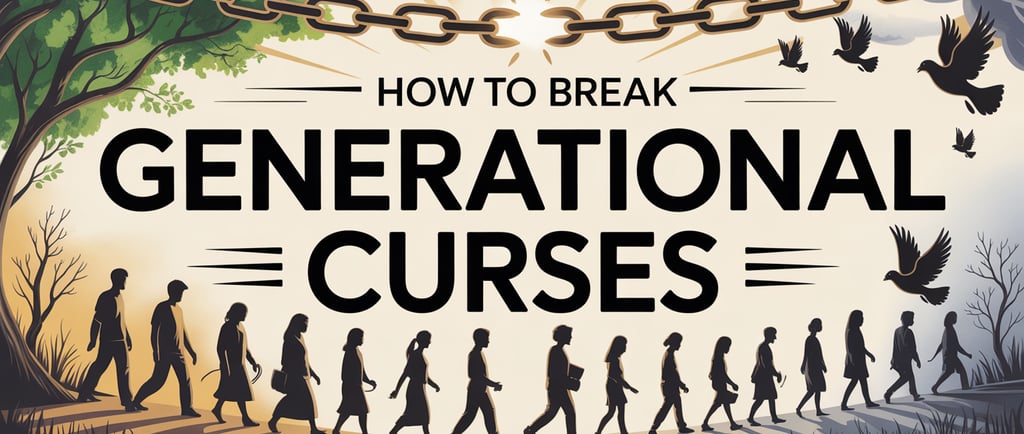
Some families feel stuck in the same patterns of anger, addiction, fear, or broken relationships. When the same wounds keep repeating from parent to child, many believers start to wonder if there is a family curse at work. By breaking family curses, we mean confronting those repeated cycles of sin, pain, and bondage in the light of Christ, so they lose their grip on you and your children.
You are not strange, weak, or “less spiritual” for asking these questions. Many sincere Christians look at their story and quietly think, “Something keeps repeating, and I do not want to pass this on.” The Bible does speak of the consequences of sin touching several generations (Exodus 20:5-6), yet it also makes clear that each person is responsible before God and can walk in a new path (Ezekiel 18:20). You are not locked into your parents’ choices.
In Jesus, you are invited into real freedom, not just a new label for the same old pain. The cross breaks the power of sin and shame, and the Holy Spirit teaches you how to live in that freedom step by step. You can face what has run in your family story, repent where needed, forgive from the heart, and stand in the authority Christ has given you.
This article will guide you through a clear, Christ-centered process for breaking family curses, rooted in Scripture and supported by practical actions you can take. You will learn how to identify unhealthy patterns, renounce agreements with lies, pray with confidence, and build new, godly habits for your home. For Christian Counseling, Contact Pastor Richmond info@faithfulpathcommunity.com
What Are Generational Curses and Family Patterns?
When people talk about generational curses, they are usually describing repeated patterns that seem to run through a family story. In Scripture, we see that sin has long-term effects, but we also see that God steps into broken family lines with mercy, especially through Jesus Christ.
In this guide to breaking family curses, we are not trying to create fear or superstition. We are learning to recognize unhealthy family patterns, then bring them into the light of the cross so those patterns lose their power. Think of it less like a spooky curse and more like deeply worn paths in the soul that God wants to gently redirect.
As you read, remember: if you belong to Christ, you are not doomed to repeat your parents’ choices. You may have battles to fight, but you fight them from a place of victory, not defeat.
For a helpful theological example of how God works even through complicated family lines, you can see how scholars discuss inherited issues and royal curses in Jesus’ family tree in this article on exploring generational curses within Jesus' genealogy.
Common Signs You May Be Facing a Generational Pattern
Most people sense generational patterns not through visions or dramatic experiences, but through everyday struggles that seem to repeat. These are not automatic proof that you are under a curse. They are gentle invitations to bring your family story before God.
Some common signs include:
Repeating sins or addictions
You may notice similar addictions, secret habits, or destructive coping mechanisms in parents, grandparents, and siblings. Maybe anger, alcohol, pornography, or workaholism keeps showing up in different forms. The pattern suggests places where your family has learned to run to the wrong refuge.Similar broken relationships
Divorce, emotional distance, or ongoing conflict might appear generation after generation. You might hear comments like, “In our family, marriages just do not last,” or “Our family has always been like this,” and feel a quiet grief about it.Repeated betrayal or abandonment
Stories of absent fathers, unfaithful spouses, or close friends who walk away can echo across decades. When you expect abandonment before it happens, that may point to a long history of broken trust.Ongoing shame and self-hatred
Some families live under a heavy sense of “We are the problem” or “Nothing good comes from us.” Jokes about the family being “cursed” or “messed up” may hide a deep, shared self-contempt.Long-standing fear, anxiety, or anger that “runs in the family”
You may see similar reactions in multiple generations: explosive rage, chronic worry, or constant defensiveness. The emotion becomes part of the family identity instead of something to heal.History of occult involvement or deep bitterness
Involvement with witchcraft, fortune-telling, curses, or long-term unforgiveness can open doors to spiritual bondage that affect children and grandchildren.
If you see yourself in some of these patterns, do not panic. These signs do not mean God has rejected you. They simply highlight areas where the Holy Spirit wants to bring healing, truth, and freedom as you walk through breaking family curses with Jesus.
What the Bible Really Says About Generational Curses
Scripture is honest about how sin affects families, but it is just as clear about personal responsibility and Christ’s power to set people free.
In Exodus 20:5-6, God says He “visits the iniquity of the fathers on the children to the third and the fourth generation of those who hate Me, but shows steadfast love to thousands of those who love Me and keep My commandments.” This passage does not picture God as harsh or unfair. It shows that sin has real consequences that ripple through generations, yet it also highlights that His mercy is far greater and reaches thousands of generations.
Later, through the prophet Ezekiel, God speaks directly against the idea that children are punished for their parents’ sins. Ezekiel 18:20 says, “The soul who sins shall die. The son shall not suffer for the iniquity of the father.” Each person stands before God for their own choices. You may feel the impact of your parents’ sin, but you are not held guilty for it.
The New Testament takes this even further. Galatians 3:13 declares, “Christ redeemed us from the curse of the law by becoming a curse for us.” On the cross, Jesus took every curse, judgment, and accusation that stood against you. That means no Christian is stuck in a spiritual prison because of their ancestors. Any teaching that tells a believer they are hopelessly trapped by a generational curse ignores what Jesus has already finished.
A helpful Christian overview on this topic is the article from GotQuestions, which explains how Scripture treats breaking generational curses in light of Christ’s work. Another pastoral perspective from Focus on the Family unpacks the “generational curse” language in Exodus 34:7 and emphasizes God’s justice and mercy.
So what are we really doing when we talk about breaking family curses?
We are agreeing with what Jesus has already done, not trying to add to His work.
We are renouncing sinful family patterns and choosing obedience in the power of the Spirit.
We are receiving healing where family wounds have shaped how we think, feel, and relate.
We are taking responsibility for our own sin instead of blaming our parents.
You may still have to fight familiar battles, but in Christ you fight as a loved child of God, not as a doomed victim of your bloodline. Any generational curse loses its legal right at the cross. Your role now is to stand in that truth, walk it out, and invite God to write a different story for you and your children.
For Christian Counseling, Contact Pastor Richmond info@faithfulpathcommunity.com
Step 1: Bring Your Family Story Into God’s Light
Breaking family curses starts with honesty in God’s presence. Before you renounce anything or make declarations, you slow down, listen, and let the Holy Spirit show you what has been shaping your family line. This is not about blaming your parents or shaming your last name. It is about inviting the Lord to shine light on what has been hidden so His truth, mercy, and power can begin to rewrite your story.
As you walk through this step, take your time. You are not just making a list, you are meeting God in the details of your family history.
Naming the Patterns: What Do You See in Your Family Line?
Begin with prayer. Quiet your mind and simply say, “Holy Spirit, help me see my family story the way You see it. Show me what needs healing and where Your grace has already been at work.”
Then, take a notebook and start writing what comes to mind. Look for three kinds of repeated patterns:
Repeated sins: These are behaviors that break God’s design for life and love. You might see anger, control, sexual sin, adultery, addiction, dishonesty, greed, or involvement in the occult showing up across several generations. Note where you see them and how they have affected you.
Repeated wounds: These are hurts that keep echoing. Maybe your family story is marked by rejection, abandonment, harsh criticism, emotional distance, favoritism, or secrecy. Write what you remember from stories, conversations, and your own experience.
Repeated beliefs: These are phrases and “family truths” that shape how everyone thinks. Things like “we will always struggle,” “no one can be trusted,” “men in our family never change,” or “this is just how our people are.” These beliefs often hold more power than we realize and can keep family curses in place.
As you write, also look for places of grace. Where did someone choose faithfulness, kindness, or sacrifice? Who prayed for you? Who broke a pattern even a little? Noting those moments reminds you that God has already been at work in your family line.
This step is not about passing judgment on parents or grandparents. Many of them were walking with the light they had. Naming patterns simply gives you language to bring them before God so He can heal, forgive, and redirect. If you need a deeper guide on how repeated spiritual struggles form, the article on breaking spiritual strongholds with prayer can help you think through what may be active in your story.
Inviting God Into Your Family History
Once you have written what you see, you do not carry it alone. You place your family story into the hands of Jesus and invite Him to walk through it with you.
Picture your family timeline in front of you: grandparents, parents, aunts, uncles, your own life, and your children or future children. Now picture Jesus standing in the middle of that line. He is not pointing fingers or waiting to punish. He is the Savior who already stretched out His arms on the cross so that every sin, curse, and shame could meet its match in His blood.
You might pray something like this:
“Lord Jesus, thank You that Your cross is stronger than every sin and every curse. I invite You into my family history. Shine Your light on what is true, and expose every lie I have believed about my family and myself. Show me where there has been sin, where there has been pain, and where there has been Your grace. Separate what really happened from the lies of the enemy. I give You every pattern I have written down, and I ask You to begin Your healing work in me and in my family line. In Your name, Jesus, amen.”
As you pray, stay expectant. The same God who calls families to repentance and renewal, as seen in the Minor Prophets’ call to repentance, is the God who now speaks into your home. Nothing in your family history is stronger than the cross. This first step positions you to walk out breaking family curses with clarity, humility, and hope.
For Christian Counseling, Contact Pastor Richmond info@faithfulpathcommunity.com
Step 2: Break Agreement With Sin Through Repentance and Forgiveness
Once you have named the patterns in your family story, the next step in breaking family curses is to respond to God with repentance and forgiveness. You are not trying to fix your whole family line in one moment. You are choosing to break your personal agreement with sin and bitterness so those patterns lose their grip on you.
In this step, you come out of agreement with harmful ways of living and thinking, and you agree with God’s truth instead.
Repenting for Your Own Sin and Family Patterns
Repentance is not about carrying the full weight of everything your ancestors did. Scripture is clear that each person answers to God for their own choices. Repentance is your way of saying, “I will not keep walking in this sin, even if it feels normal in my family.”
Many of us learned our reactions at home. If you grew up with constant anger, criticism, or emotional withdrawal, those patterns can feel automatic. When you repent, you are not dishonoring your parents, you are choosing a new path. You might pray something like, “Lord, I confess my anger and the way I followed what I saw at home. I turn from it and choose Your way.”
Repentance includes three simple parts:
Confess the sin you have personally walked in.
Take responsibility, without blaming your family, culture, or triggers.
Turn to God’s way, asking for the Holy Spirit’s help.
A simple prayer of repentance could be:
“Lord Jesus, I confess that I have sinned in my thoughts, words, and actions. I confess the ways I have followed unhealthy patterns from my family, especially in the area of __________. I turn away from this sin and I choose Your way instead. Thank You that by Your blood I am forgiven and cleansed. Fill me with Your Holy Spirit and teach me to walk in freedom. In Your name, amen.”
God does not meet true repentance with shame. He meets it with mercy. First John 1:9 promises that when we confess our sins, He is faithful to forgive and cleanse us. If you want to go deeper into how repentance and change show real spiritual growth, you may find help in this guide on distinguishing spiritual growth from empty habits.
Choosing Forgiveness So Bitterness Loses Its Power
Unforgiveness is one of the main ways family pain keeps passing from generation to generation. When you hold on to resentment toward a parent, grandparent, or anyone else, the wound stays open. Old memories keep their sting, and the enemy uses that pain to push you toward the same patterns you hate.
Bitterness can feel like strength. It can feel like a shield that keeps you from being hurt again. In reality, it is more like a chain around your own heart. You replay what happened, you rehearse what you wish you had said, and your emotions stay tied to the past. Forgiveness breaks that chain.
Choosing forgiveness means:
You release the person from your personal judgment.
You give the situation into God’s hands for justice and healing.
You refuse to keep drinking the poison of bitterness.
Forgiveness does not mean:
Pretending it did not hurt.
Saying what happened was okay.
Trusting the person right away, or at all, if they remain unsafe.
As you work through breaking family curses, forgiveness is how you stop passing the poison forward. When you forgive, you cut off the flow of anger and revenge that often travels through generations. You open space for God’s healing and for new, healthier ways of relating.
You might pause and quietly name those you need to forgive: “Lord, I choose to forgive my father for __________, my mother for __________, my grandfather for __________.” Then speak a simple choice before God, out loud if you can:
“Father, in Jesus’ name, I choose to forgive __________ for __________. I release them from my judgment and give this hurt to You. I let go of bitterness, anger, and the right to pay them back. Heal my heart and break every chain that has come through this wound. I choose Your freedom instead of resentment. In Jesus’ name, amen.”
Forgiveness is often a process, especially with deep wounds. If you need more support, this teaching on how to forgive deep hurt can walk with you step by step. As you keep choosing forgiveness, the power of old pains weakens, and your home becomes a different kind of spiritual environment.
For Christian Counseling, Contact Pastor Richmond info@faithfulpathcommunity.com
Step 3: Stand in Your New Identity in Christ
Breaking family curses is not only about what you leave behind. It is about who you are now in Jesus. In this step, you choose to stand in your new identity in Christ, even when old feelings and patterns try to pull you back. Your story is no longer defined by your bloodline, but by His blood and His finished work on the cross.
If you want more help learning how to think from this new place in Christ, the article on living with a renewed mind in Christ can give you a deeper foundation.
What It Means to Be Free From Curses in Jesus
Galatians 3:13 says that Christ redeemed us from the curse of the law by becoming a curse for us. In simple terms, Jesus took the full weight of judgment that the law demanded and carried it in His own body at the cross. For the everyday Christian, that means you are no longer under any curse in a legal, spiritual sense.
You might still feel a pull toward old habits, reactions, or family patterns. That pull is real, but it is not the same as being under a curse. Think of it like this:
Old patterns are like ruts in a dirt road. Your mind and emotions are used to going that way.
A curse is a legal sentence over your life.
At the cross, Jesus removed the sentence. Now, with the Holy Spirit, you learn to drive out of those old ruts and form a new road. You are not trying to get free from a curse that still has a claim on you. You are standing in freedom that Jesus already bought for you.
If you want to study this more, you can read a clear explanation of what Galatians 3:13 means for believers. It will confirm that your freedom is based on Christ, not your feelings.
Your family history, any occult past, and generations of sin are all weaker than the blood of Jesus. Right where you are, you can say out loud:
“Thank You, Jesus, that You took the curse for me. I belong to You. No curse has a legal right over my life anymore.”
As you thank Him, you are agreeing with what is already true in heaven and learning to walk in it on earth.
Declaring God’s Promises Over Your Life and Family
Standing in your new identity involves your mouth, not just your mind. When you speak God’s Word over your life and family, you are lining up your thoughts, emotions, and atmosphere with His truth. This is a key part of breaking family curses and building a new, Christ-centered legacy.
Scripture calls you a new creation, free from condemnation, and invited to choose life. Here are a few simple declarations, drawn from key verses:
From 2 Corinthians 5:17 (new creation):
“In Christ I am a new creation. The old has gone, the new has come into my life and my family.”From Romans 8:1 (no condemnation):
“There is no condemnation for me in Christ Jesus. Shame and accusation will not rule my heart or my home.”From Deuteronomy 30:19 (choosing life):
“By God’s grace, I choose life, blessing, and obedience for myself and my family line.”
You might also find it helpful to review Scriptures that explain who God says you are in Christ. Let those verses shape your declarations.
To make this personal, try writing 3–5 short statements that fit your story. For example:
“In Jesus’ name, addiction stops with me. My children will know peace and self-control.”
“In Christ, I am not defined by anger. I am patient, gentle, and slow to speak.”
“Our home belongs to Jesus. His presence, not fear, fills these rooms.”
Speak these out loud in prayer, over your day, and even in your home. You are not trying to talk yourself into something fake. You are agreeing with what God already says is true, and that agreement helps break the momentum of old patterns.
For Christian Counseling, Contact Pastor Richmond info@faithfulpathcommunity.com
Step 4: Build New Habits That End Old Family Cycles
When you address spiritual roots and forgive, the next step is to live differently day by day. Family patterns change when new choices become normal. You do not need a perfect plan, just a steady one. Small, repeated, Christ-centered habits can turn the direction of an entire family line and are a key part of breaking family curses in real life.
Setting Healthy Boundaries and Making Different Choices
Healthy boundaries in a Christian home are about love with wisdom. They protect your heart, your children, and the work God is doing in you. Boundaries are not selfish. They are a way of saying, “This belongs in my life,” and, “That does not,” in light of God’s truth.
Healthy boundaries can look like:
Saying no to abuse or constant disrespect, even from family.
Limiting time with people who push you toward addiction, gossip, or sin.
Refusing to join in hateful talk, name-calling, or shaming.
Seeking help for addiction, instead of hiding it.
Choosing calm problem-solving instead of explosive arguments.
It often comes down to replacing “old way” choices with “new way” ones. For example:
Old way: Yelling, slamming doors, using insults.
New way: Taking a break to cool down, then having a calm, honest talk.Old way: Hiding sin, deleting messages, keeping secrets.
New way: Confessing early to God and a trusted person, asking for prayer and help.Old way: Isolating when stressed, pulling away from church and family.
New way: Reaching out to safe friends, small groups, or your pastor for support.Old way: Letting work or ministry swallow all your energy.
New way: Learning Christian strategies for work-life harmony so your home has your presence, not just your leftovers.Old way: Repeating hurtful phrases you heard growing up.
New way: Choosing words that bless, even when you correct.
Each new choice can feel small, but repeated over months and years it creates a new “normal” for your home. Think of it like turning a ship one degree at a time. It may not look dramatic today, but in the long run it leads to a very different shore.
Inviting the Holy Spirit Into Your Daily Habits
New habits have real power when the Holy Spirit fills them. You are not trying to outwork your family history in your own strength. You are inviting God into the parts of your day that often run on autopilot.
Simple daily rhythms that support freedom include:
Regular prayer: Short, honest talks with God when you wake up, drive, or take a walk.
Bible intake: Reading a small portion daily, or listening to Scripture as you commute.
Worship: Playing worship music at home, singing at church, or silently thanking God.
Life-giving friendships: Spending time with believers who call you higher and pray with you.
Active church involvement: Serving, joining a group, or simply showing up consistently.
Romans 12:1-2 paints the picture: offer your body as a living sacrifice, and be transformed by the renewing of your mind. These habits are how you place your ordinary life on the altar every day. They give the Spirit room to reshape how you think, react, and decide. For a deeper look at how God reshapes the mind, the message on the renewed mind and how to have it offers rich, practical teaching.
The Holy Spirit gives strength to do what past generations could not. Where others felt stuck, He teaches you to forgive, to stay sober, to tell the truth, to stay present in your home. Over time, these Spirit-led habits weaken the pull of old patterns and support real breaking of family curses.
Do not try to rebuild your whole life in a week. Ask the Lord, “Which one or two habits should I start this week?” Maybe it is ten minutes of Scripture before your phone, or committing to church every Sunday for the next month. Start small, stay consistent, and trust that God loves to bless simple obedience.
For Christian Counseling, Contact Pastor Richmond info@faithfulpathcommunity.com
Step 5: Seek Wise Support and Ongoing Healing
Breaking family curses is not a solo project. God designed healing to happen in the context of the body of Christ, through prayer, honest relationships, and wise guidance over time. As you keep walking out your freedom, you need people who can stand with you, remind you of truth, and help you keep choosing a new way when old patterns feel strong.
You are already doing the hard work of facing your story and responding to God. This step is about not doing that work alone.
Why Community Matters When You Are Breaking Family Curses
When you are breaking family curses, isolation is dangerous. Old habits grow in the dark, but healing grows in the light of safe, Christ-centered community. God uses people to help us see what we cannot see, to pray when we feel weak, and to model what a healthy, Spirit-led life looks like.
Healthy community might look like:
A small group where you study Scripture, pray together, and talk honestly about real struggles.
One or two prayer partners who check in with you, agree with you in prayer, and stand with you when spiritual warfare feels heavy.
A mentor who is a bit further along in faith and family life, who can share wisdom and gently challenge unhealthy patterns.
Faithful friends who speak truth in love, not gossip or shame.
You do not need to tell your story to everyone. In fact, sharing with everyone can invite confusion and unnecessary opinions. Instead, ask God to highlight a few trusted, mature believers who are safe, discreet, and rooted in Scripture. Start small. Share a part of your story, see how they handle it, and build trust over time.
Shame feeds on secrecy. When you bring your battles into loving Christian community, shame starts to lose its voice. Honest confession, mutual support, and shared prayer open the door for deep healing, especially if your wounds involve church hurt or control. If you are processing painful spiritual experiences, this healing from religious trauma guide can help you think through how to re-engage with community in a healthy way.
Remember, community does not replace Christ, but it reflects Him. As you walk with others, God uses their gifts, strengths, and stories to support your own journey of ongoing freedom.
When to Consider Christian Counseling or Pastoral Help
Sometimes the patterns you face are so deep or painful that added support is wise. Prayer, Bible reading, and community remain essential, but you may also need focused help from a trained Christian counselor or a trusted pastor.
It may be time to seek counseling or pastoral care if:
You have a history of trauma or abuse that still affects your relationships, sleep, or sense of safety.
You battle ongoing depression or anxiety, and it remains even as you pray, worship, and stay in community.
You feel a strong pull toward self-harm, addiction, or suicidal thoughts.
You feel stuck in the same patterns, even after repentance, forgiveness, and sincere efforts to change.
Your marriage or family feels trapped in cycles of fear, control, or emotional disconnection.
A Bible-centered Christian counselor or pastor will take Scripture seriously, honor the work of the Holy Spirit, and also understand how the mind, body, and emotions work together. Good counseling is not a lack of faith, it is a wise use of help that God provides. Resources like Faithful Path Christian Counseling exist to walk with believers who need structured, faith-filled support.
You do not have to wait until you are in crisis. If you sense the Holy Spirit nudging you to get help, that is often His kindness, not His criticism. For Christian counseling or pastoral support, you can contact Pastor Richmond at info@faithfulpathcommunity.com.
For Christian Counseling, Contact Pastor Richmond info@faithfulpathcommunity.com
Conclusion
Generational patterns are real, but in Christ you are not trapped. Breaking family curses means bringing your story into God’s light, turning from sin, choosing forgiveness, standing in your new identity in Jesus, building different habits, and walking with wise, loving support. When you do this with the Holy Spirit’s help, what once felt like a family sentence becomes a place of testimony and grace. For a deeper biblical overview of how this works, you can also read Faithful Path’s guide to generational curses.
You may feel weak, tired, or unsure, but change can start with you. God is not asking you to fix your whole family story in one moment. He is inviting you to trust Him with the next obedient step. Your yes today can echo into your children and your children’s children.
Let this be your simple next step: choose one truth, one habit, or one act of forgiveness from this guide, and practice it with God today. Then pray:
“Lord Jesus, I give You my family story, my past, and my future. I surrender every pattern of sin, fear, and pain that has shaped us. I trust that Your cross is enough and that Your Spirit is at work in me. Write a new story over my life and my family line, for Your glory. In Your name, amen.”
May the peace of Christ guard your heart and home. May His blessing rest on you, your household, and every generation that follows.
For Christian Counseling, Contact Pastor Richmond info@faithfulpathcommunity.com