
Purity for Christian Men: Overcoming Lust and Pornography (Step-by-Step Freedom Plan)
Purity for Christian men, step-by-step plan to break lust and porn with faith, guardrails, and support. Counseling: info@faithfulpathcommunity.com
Richmond Kobe
12/21/202514 min read
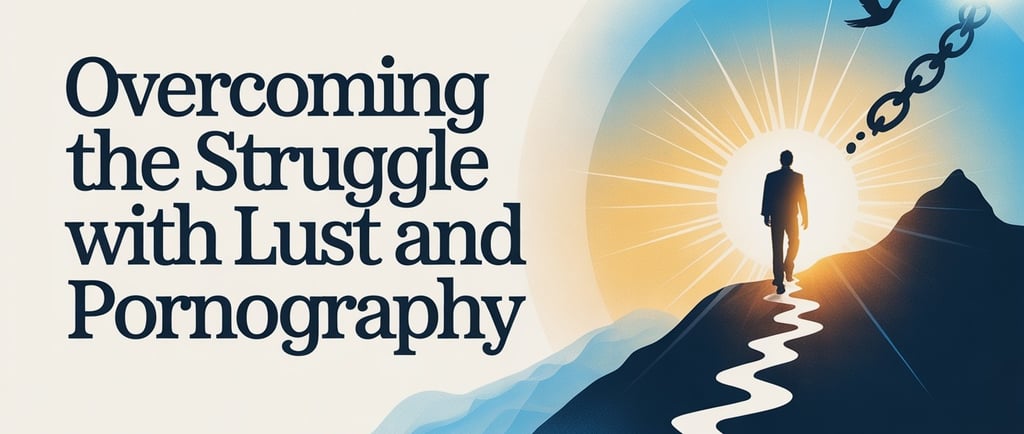

If you’re a Christian man fighting lust and pornography, you’re not alone, and you’re not beyond God’s help. The shame can feel heavy, the secrecy can feel safer than the truth, and the fear of being found out can keep you stuck.
This struggle is also more common than most people admit. Recent U.S. self-reported surveys suggest roughly two-thirds to three-quarters of men say they view pornography at least sometimes, and about 10 to 11% of men say they’re addicted, though wording and definitions vary from study to study.
But common doesn’t mean harmless, and it doesn’t mean you have to settle for a double life. Freedom is possible, with honest repentance, wise boundaries, and real support that doesn’t shame you.
This post lays out a clear, step-by-step path toward purity for Christian men, covering spiritual habits, practical safeguards, and relational healing you can start today. If you need Christian Counseling, Contact Pastor Richmond at info@faithfulpathcommunity.com. You can also find faith-building resources in our spiritual growth guide for Christian men.
Understand the battle, lust is not just a habit, it’s a heart and brain pattern
If you only treat lust like a bad habit, you’ll fight the wrong enemy. Yes, there are choices involved, but there are also patterns you’ve practiced for years, inside your mind and inside your body. That’s why you can feel sincere in prayer on Sunday and still get pulled toward compromise on Tuesday night.
Purity for Christian men starts with clarity. Lust is not only about behavior; it’s about what you’ve trained your heart to want, and what you’ve trained your brain to reach for when you’re tired, lonely, stressed, or bored. When you understand the pattern, you stop being shocked by the struggle, and you start building a real plan to change it.
What the Bible means by lust, and why it harms you and others
In plain terms, lust is using a person as an object in your mind. It’s taking someone made in God’s image and turning them into a tool for escape, comfort, control, or fantasy. Even if nobody else knows, your inner world matters, because it shapes what you love and how you treat people.
Jesus addressed this directly. In Matthew 5:27-28, He points past the surface act and aims at the heart, the place where desire and decisions start. He’s not trying to crush you with impossible standards; He’s telling the truth about how sin works. It begins inside, then it spills out. If you want help unpacking His words in everyday language, this overview is useful: What does it mean to lust in your heart (Matthew 5:28)?
Lust always has a cost. It might feel private, but it never stays contained:
Your conscience: You get used to ignoring inner warnings. That numbness doesn’t stay limited to porn or fantasies, it bleeds into other choices.
Your joy: You can still function, but joy gets thin. Worship feels strained, prayer feels awkward, and gratitude fades.
Your respect for others: You start scanning bodies instead of seeing people. You may become more critical, entitled, or impatient.
Your intimacy: Lust trains you to want quick reward without real connection. That makes dating, marriage, and honest friendship harder, not easier.
One practical takeaway can change the tone of your fight: you can confess sin without hating yourself. Repentance says, “Lord, I was wrong, I need mercy, and I’m turning.” Self-hatred says, “I’m disgusting, I’m doomed, I should hide.” Confession keeps you in the light, where healing happens.
Why pornography feels powerful, and why willpower often fails
Pornography often feels powerful because it offers a fast, predictable payoff. Real relationships take courage, patience, and humility. Porn offers the opposite: control, novelty, and no risk of rejection. Over time, many men report that it trains their mind to expect sexual stimulation on demand, especially when life feels heavy.
A simple way to understand the pull is the cue, craving, reward loop:
Cue: Something triggers you. It might be your phone in bed, being home alone, late-night scrolling, a bad day, or even success followed by a letdown.
Craving: Your mind starts bargaining. “Just a peek.” “I deserve it.” “I need to relax.” The urge feels like a problem that must be solved now.
Reward: Temporary relief hits, then fades. Afterward, many men feel regret, dullness, or the need to hide.
Here’s what this can look like in real life:
Phone at night: You’re tired, guard is down, and privacy is high.
Stress after work: Porn becomes a way to shut off pressure without talking to anyone.
Being alone: The quiet feels unsafe, so you reach for something loud and fast.
Willpower often fails because willpower mainly fights at the moment of temptation, which is usually the worst time to start a plan. If you keep your normal routines and just promise yourself harder next time, you’re asking a tired brain to beat a rehearsed pattern.
Many men also report that repeated porn use can dull desire for real connection. It can make normal affection feel less exciting, and it can increase secrecy because the habit doesn’t fit who you want to be. Secrecy then becomes fuel for the cycle. You feel isolated, so you act out, then you feel more isolated.
If you want to understand how cues and craving can become wired through repetition (without turning this into a medical debate), this research overview may help: Neurobiology of cue-reactivity, craving, and inhibitory control in non-substance addictive behaviors.
Shame vs conviction, learn to tell the difference
If you confuse shame with conviction, you’ll keep running from the very help you need. Conviction is God’s alarm that leads you back to Him. Shame is the enemy’s fog that keeps you stuck.
Here’s the difference in plain terms:
Conviction says: “This is wrong, come back to God, make it right, take the next step.”
Shame says: “You’re filthy, you’re fake, you’ll never change, so you might as well keep hiding.”
Shame often sounds spiritual, but it produces the opposite of spiritual fruit. It isolates you. It makes prayer feel pointless. It makes you think you don’t belong with God’s people.
Below are common shame thoughts, with healthier truth replacements you can practice in the moment:
Shame thought: “I already failed, so the day is ruined.”
Truth replacement: “I can repent right now. One fall doesn’t get to define my whole day.”Shame thought: “If anyone knew, they’d reject me.”
Truth replacement: “Sin grows in secrecy. The safest path is honest help and wise support.”Shame thought: “God is tired of me.”
Truth replacement: “God calls me to confession and change. He doesn’t call me to hiding.”
Conviction points to a specific next step, like confession, prayer, filtering your phone, or texting an accountability partner. Shame points to vague hopelessness. If you need a deeper explanation from a Christian counseling angle, this can clarify the difference: Shame vs. Conviction: Knowing the Difference.
If you’re overwhelmed, don’t white-knuckle this alone. For Christian Counseling, Contact Pastor Richmond info@faithfulpathcommunity.com.
Build a clear plan for purity, remove triggers, add guardrails, and practice new habits
If you want purity for Christian men to move from a good intention to a new normal, you need a plan that works on ordinary days, not just spiritual “high” moments. A clear plan does four things: it exposes your patterns, removes easy access, adds guardrails that hold when you feel weak, and replaces the old habit with a new response.
Think of it like a fire plan for your home. You don’t wait for smoke to make decisions. You set alarms, clear clutter, and practice what you’ll do when the heat rises.
Know your triggers and patterns, then plan for them
Most men don’t “randomly” fall. They repeat a script. The first win is to stop being surprised by your own patterns.
Track urges for 7 days. Keep it simple, use a notes app or a small notebook. You’re not writing a novel, you’re collecting clues. Each time you feel an urge (even if you don’t act on it), jot down:
Time: When did it hit?
Place: Where were you?
Mood: What were you feeling (stressed, lonely, bored, angry, rejected, tired)?
Device: What were you on (phone, laptop, TV, gaming console)?
What happened right before: A conversation, a show, social media, being home alone, a drink?
After seven days, circle repeats. Many men notice two or three “hot zones,” not twenty.
Here are common triggers to watch for, because they show up again and again:
Late-night scrolling: Tired brain, low resolve, high privacy.
Loneliness: Not always “no one loves me,” sometimes “I feel unseen.”
Conflict with your spouse: Hurt feelings turn into “I deserve comfort.”
Stress: Porn becomes a pressure release valve.
Alcohol: Lowered restraint, blurred judgment.
Fatigue: You want easy relief, not a hard choice.
Once you spot your pattern, plan for it with one or two small moves. Example: if your danger zone is 10:30 pm in bed on your phone, your plan is not “try harder,” it’s “phone leaves the bedroom by 9:30 pm.”
If you want help naming and redirecting triggers in more detail, this guide is a solid reference: https://www.covenanteyes.com/blog/the-ultimate-guide-to-identifying-and-redirecting-your-porn-triggers/
End with one simple rule you can use in the moment: name it, then choose a next step.
Name it: “I’m stressed and tired.” Next step: “I’m going to stand up, leave this room, and text my accountability partner.”
Set guardrails that actually work (phone, filters, and friction)
Guardrails are not punishment. They are wisdom. If your life has a cliff, you don’t prove your strength by driving close to the edge.
A key principle is friction. The goal is to make porn and lust harder to access, slower to reach, and easier to interrupt. Feelings change fast. Friction buys you time to choose.
Practical guardrails that many men find effective:
Move your phone out of the bedroom: Bedrooms are for sleep and intimacy, not private temptation.
Charge your phone in the kitchen: One small habit that removes hours of late-night access.
Remove private browsing options where possible: Turn off or restrict private modes, and clean up apps that act like hidden doorways.
Use accountability software: Pick tools that send reports to a trusted person and block explicit content. What matters is follow-through, not finding the perfect app.
Block adult content at the router level if you can: This protects every device on your home network and adds a strong layer of friction.
Limit social media: For many men, social feeds are not “neutral,” they are a trigger pipeline. Remove apps, set time limits, or keep them off your phone entirely.
A helpful way to evaluate a guardrail is to ask: “Will this still help me at 11:45 pm when I’m lonely and tired?” If the answer is no, add friction.
If you want an overview of options people use for accountability and filtering, this roundup can give you categories to consider (without you needing to adopt every suggestion): https://everaccountable.com/blog/covenant-eyes-alternatives/
If you need Christian Counseling, Contact Pastor Richmond at info@faithfulpathcommunity.com.
Replace the habit, what to do in the first 10 minutes of an urge
When an urge hits, you don’t need a perfect day. You need a simple script you can follow while your brain is loud.
Urges often rise and fall like a wave. If you don’t feed it, it usually loses force. Your job is to ride it out and redirect your body and mind for ten minutes.
Use this short “urge script”:
Pause: Say, “Stop. This is a moment, not a mandate.”
Breathe: Take 10 slow breaths. Long exhale, relaxed shoulders.
Pray (short and direct): “Lord Jesus, have mercy on me. Help me choose what honors You.”
Leave the room: Change location right away. Movement breaks the trance.
Do one physical action: Push-ups, a fast walk, cold water on your face, take out the trash, anything that shifts your body.
Text or call your accountability partner: Keep it simple: “Urge right now. Please pray. I’m choosing the next right thing.”
Do something purposeful for 10 minutes: Shower, read a Psalm, prep tomorrow’s lunch, journal, fold laundry, review a goal, clean one space.
If you want a structured example of “urge surfing” language, this worksheet can help you put words to what’s happening in your body and thoughts: https://www.therapistaid.com/therapy-worksheet/urge-surfing-script
Keep your goal small. You are not promising, “I’ll never struggle again.” You’re choosing, “I will obey for the next ten minutes.”
Create a relapse response plan so one fall doesn’t become a binge
Many men don’t spiral because of one bad choice. They spiral because shame says, “You already blew it, keep going.” Your relapse response plan is how you cut off that lie early.
It helps to know the difference:
A lapse is a slip, a moment of compromise, a wrong choice you stop quickly.
A relapse cycle is when you return to the pattern, hide it, and keep feeding it over days or weeks.
Your plan is to treat a lapse like a fire alarm, not a funeral.
Use this 5-step response as soon as possible:
Stop: End the behavior quickly. Close the device, leave the room, get upright.
Confess to God: Be specific, no drama, no excuses. Receive mercy and turn back.
Tell a trusted person within 24 hours: Exposure kills secrecy. Make it factual: what happened, when, and what you’ll change.
Remove access immediately: Tighten guardrails the same day (move devices, block sites, delete apps, change passwords, add accountability).
Review and adjust: Ask, “What was the trigger, what was my first compromise, and what guardrail would have stopped this sooner?” Then update your plan.
This is hope-filled, not permissive. Grace is not permission to stay stuck. Grace is power to get back up and walk in the light again.
If you feel out of control, or porn use is tied to substance use or mental health crisis, reach out for help right away. A starting point for finding support is the SAMHSA National Helpline: https://www.samhsa.gov/find-help/helplines/national-helpline
Heal the roots, grow your walk with God, renew your mind, and rebuild your desires
Lasting purity for Christian men is more than blocking websites. It’s letting God reach the roots, reshaping what you love, and training your mind to run toward Him when pressure hits.
Daily time with God that fits real schedules
Consistency beats intensity. Use this simple 10-minute plan:
2 minutes stillness (breathe, sit, no phone)
5 minutes Scripture (rotate: Psalm 51, Romans 12:1-2, 1 Corinthians 10:13, Philippians 4:8)
2 minutes prayer (confess, ask for help, thank Him)
1 minute plan (one boundary, one next right step)
If you want a structured reading approach, see The Bible, Help with Victory Over Porn Addiction.
Renew your mind, change what you feed your eyes and thoughts
Your inputs shape your cravings. Music, shows, social media, flirting, and fantasy don’t stay neutral; they plant seeds.
Try a gentle media audit for one week: notice what stirs lust, comparison, or boredom, then remove one source at a time. Replace it with better fuel: a hobby, training, learning, serving, or time outside. Philippians 4:8 becomes practical when you choose what gets your attention.
When lust is covering pain, learn healthier ways to cope
Sometimes lust is a cover for pain: rejection, trauma history, anxiety, depression, marriage conflict, or stress. If that’s you, asking for help is not weak, it’s mature faith.
Pastoral care and counseling can help you name the wound and learn new coping skills. For Christian Counseling, Contact Pastor Richmond info@faithfulpathcommunity.com.
Don’t fight alone, accountability, confession, and support that leads to freedom
Private sin grows best in private spaces. That’s why so many men stay stuck even after sincere promises, long prayers, and strong willpower. Purity for Christian men is not a solo sport. God often brings freedom through the humble path of bringing things into the light, with the right people, in the right way.
The goal is not to create a life of fear and monitoring. The goal is to build a life of truth, support, and steady obedience where temptation loses its power over time.
What real accountability looks like (and what it doesn’t)
Real accountability is a clear agreement with a trusted brother (or small group) where you both commit to honesty, prayer, and action. It has structure, and it has warmth. You can exhale because you’re not performing anymore.
What real accountability includes
Agreed check-ins: Same day, same time, same format (call, text, in-person).
Honest questions: Clear, direct, and specific, not vague.
Prayer: Not a quick ending, but a real part of the fight.
Practical guardrails: Device rules, bedtime routines, and trigger plans.
Follow-through: Adjust the plan after a slip, and keep showing up.
What accountability is not
Shame sessions: If you leave feeling condemned, something is off.
Spying and suspicion: Reports can help, but a partner isn’t your parole officer.
Vague promises: “I’ll do better” is not a plan, it’s a wish.
One-sided pressure: Healthy accountability feels firm and safe at the same time.
If you want a deeper set of question ideas to compare with your own list, this guide is helpful: Good accountability questions when the problem is sexual sin.
Here are 8 weekly questions an accountability partner can ask (and you can answer plainly, without speeches):
Where did you face temptation this week (time, place, and trigger)?
Did you view porn, sexual content, or “almost porn” content? What did you do next?
Did you masturbate or act out sexually in any way?
Did you hide, delete, lie, or minimize anything related to lust?
How did you respond to the first urge, and what could you change next time?
Did you follow your guardrails (bedtime, phone rules, filters, blocked apps)?
How has your time with God been (Scripture, prayer, worship, fellowship)?
What is one specific step you will take in the next 7 days to walk in the light?
A strong pattern is this: truth, prayer, plan. You tell the truth, you pray right then, you decide the next step before the call ends.
Confession and grace, how to talk to God after you fail
After a fall, many men either run from God or try to pay Him back with extra guilt. Neither leads to freedom. Confession is not groveling. It’s agreeing with God about what happened, turning back, and receiving mercy so you can walk forward.
Keep it simple and real:
Confess: Name the sin without excuses.
Repent: Turn from it, and choose obedience now.
Receive forgiveness: You are not cleaning yourself up to come back. You come back to be cleaned.
Take next steps: Confess to your partner, tighten guardrails, and learn from the trigger.
If you need help putting words to this, you may find this resource useful for guided language: Prayer for sexual healing.
Here’s a simple prayer outline you can reuse anytime (not fancy, just steady):
Admit: “Lord, I sinned by ___.”
Agree: “This is wrong, and I won’t call it normal or small.”
Ask: “Please forgive me and cleanse my heart.”
Receive: “Thank You that Your mercy is real right now.”
Replace: “Help me take the next right step (text my partner, leave my phone outside the room, go to sleep, take a walk).”
Recommit: “I belong to You, and I choose purity today.”
One practical rule that keeps you from spiraling is this: don’t negotiate with shame. Confess quickly, receive grace, and move your feet toward obedience.
If you’re married, rebuild trust with patience and wise support
Marriage adds weight to this battle because secrecy does not only affect you. It affects the person you promised to love. Rebuilding trust is possible, but it usually happens slower than you want. That slowness is not punishment, it’s reality.
Start with these basics:
Stop hiding: Secrets keep the cycle alive. Truth breaks it.
Commit to change in writing: A short plan is better than emotional speeches.
Be consistent: Small daily honesty builds more trust than big moments.
Share progress, not graphic details: Your spouse needs safety, not images in their mind.
Get wise support: A pastor or counselor can help you make a disclosure plan that protects your spouse and helps you tell the truth in a healthy way.
A helpful mindset is this: you’re not trying to “convince” your spouse to trust you again. You’re choosing to become trustworthy again. That includes patience when they have questions, sorrow when they hurt, and steadiness when you feel embarrassed.
If you’re unsure what to share, choose clarity without cruelty. Confess the reality, own the pattern, explain your plan, and invite support. Avoid dumping details that create new wounds.
When you need extra help, Christian counseling and pastoral care
Some battles are bigger than a weekly call. If porn has become a long-term pattern, if your slips are escalating, or if lust is tied to anxiety, anger, trauma, or depression, it’s wise to get trained help. Counseling and pastoral care can help you find the roots, build skills, and create a plan that fits your life.
For Christian Counseling, Contact Pastor Richmond info@faithfulpathcommunity.com
Also take urgent safety seriously. If you feel out of control, or you’re harming yourself, or you’re thinking about self-harm, seek immediate local help right now (call your local emergency number or go to the nearest emergency room). Your life matters, and getting help is the right move.
Conclusion
Freedom rarely comes from one big moment, it comes from many small choices made in the light. As you keep moving forward, remember the path is simple and strong: understand your pattern so you stop getting blindsided, set guardrails that add real friction, replace the old script in the first minutes of an urge, and pursue heart change through Scripture, prayer, and honest repentance.
Progress often comes in steps, not overnight. A clean week can become a clean month, and a clean month can become a new way of life. When you slip, don’t let shame write the next chapter. Confess quickly, adjust your plan, and keep walking.
Choose one change today. Move your phone charger out of the bedroom, tell a trusted brother the truth, or start the 10-minute daily plan and do it before the day gets away from you. Small steps done consistently are how God rebuilds strength and restores joy.
If you need Christian Counseling, Contact Pastor Richmond info@faithfulpathcommunity.com
Purity for Christian men is possible because Christ meets you with mercy and power, and He calls you to keep coming into the light with steady repentance and real support.