
The Great Falling Away (Apostasy) Explained: Are We Living Through It Now?
Great Falling Away explained from 2 Thessalonians 2:3, today’s faith trends, and calm steps to stay rooted. Counseling: info@faithfulpathcommunity.com
Richmond Kobe
12/29/202516 min read
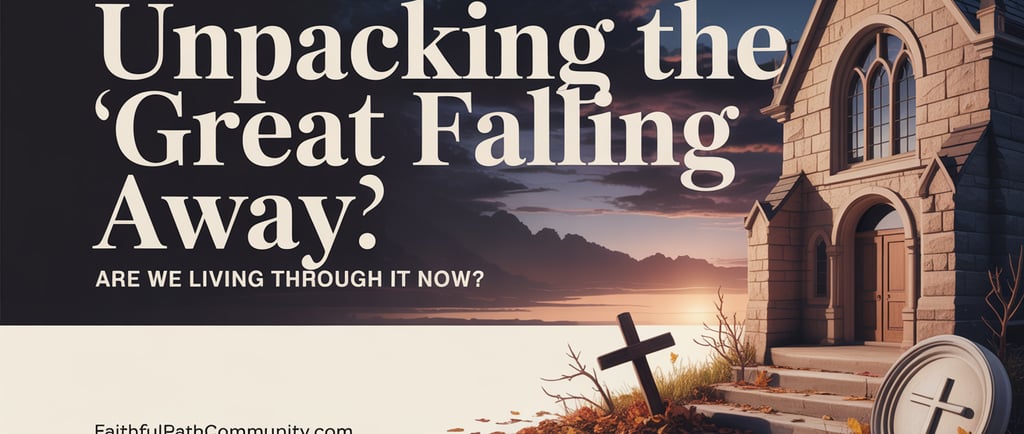
Many Christians use the phrase Great Falling Away to describe a widespread turning from biblical truth, a drift into disbelief, or a growing comfort with a faith that no longer follows Christ in word and practice. The phrase is often tied to 2 Thessalonians 2:3, where Paul warns that a “rebellion” or apostasy will come before the day of the Lord.
So are we living through it now? In many ways, yes, we’re seeing signs that look like a broad weakening of Christian commitment, especially in the West, even while God still saves, renews, and builds faithful churches. By December 2025, the topic feels urgent because more Americans report little or no religious connection, weekly church attendance remains low, and many congregations are smaller than they were before the pandemic.
This post will walk through 2 Thessalonians 2:3 in context, compare common interpretations of what the “falling away” means, and look at today’s faith trends (church attendance patterns, the rise of “nones,” and church closures). Most of all, it will offer practical ways to stay rooted in Christ, steady in Scripture, and free from panic.
For ongoing encouragement, see Spiritual growth resources at Faithful Path Community. For Christian Counseling, Contact Pastor Richmond, info@faithfulpathcommunity.com
What the Bible Means by the “Great Falling Away” (Apostasy)
When Christians talk about the Great Falling Away, they are usually referring to a serious kind of spiritual rebellion, not a bad week, not a season of questions, and not a bruised relationship with a church. Scripture treats apostasy as a weighty warning, but it also gives steadying hope. Paul’s goal in 2 Thessalonians 2 is not to stir panic, it’s to calm a shaken church and anchor them in truth.
The key passage: 2 Thessalonians 2:3 in plain English
In plain English, Paul is saying something like: Don’t let anyone trick you into thinking the day of the Lord has already arrived. Before that day comes, there will be a major rebellion against God, and a specific evil figure will be revealed, the “man of lawlessness.”
That’s the basic flow of 2 Thessalonians 2:
Paul corrects confusion: Some believers had been rattled by claims that the Lord’s return had already happened (2 Thessalonians 2:1-2). Whether it came through rumor, a false “prophecy,” or even a forged letter, the result was the same: fear and instability.
Paul gives two “not yet” markers: He says the end is not “now” because certain events must come first (2 Thessalonians 2:3). One is the rebellion (often translated “apostasy” or “falling away”). The other is the revealing of the man of lawlessness.
Paul points to a counterfeit “god” moment: This lawless figure exalts himself, opposes God, and sets himself up as worthy of worship (2 Thessalonians 2:4). The point is not to satisfy curiosity, it’s to show how bold and deceptive evil can become.
Paul calls for steadiness: The chapter moves toward a simple pastoral aim: don’t be unsettled, hold to the truth you received, and stand firm (2 Thessalonians 2:15).
It helps to be clear about what the text does and does not say.
What it does not say:
It doesn’t give a date or a timeline you can chart on a calendar.
It doesn’t invite obsession, as if every headline must be decoded.
It doesn’t tell believers to live in fear, scanning the world for hidden messages.
What it does say:
A real rebellion against God is coming (or, depending on your view, will intensify).
Deception is a serious threat, even to church communities.
The right response is steadiness, not frenzy, and faithfulness, not fixation.
If you want a deeper verse by verse explanation of how people interpret “falling away” in this passage, Christian Courier’s discussion of 2 Thessalonians 2:3 offers helpful context and word study.
Apostasy vs. doubt, burnout, and church hurt
One reason the Great Falling Away topic gets messy is because people use the word apostasy for almost anything that looks like spiritual struggle. The Bible’s warnings are real, but we should be careful with our labels. A bruised believer needs care, not suspicion.
Here are categories that are worth separating:
Honest questions: Asking “Is God real?” or “Why does suffering happen?” is not the same as rejecting Christ. Many faithful Christians have wrestled hard and grown stronger. Questions can be a doorway to deeper trust.
Temporary drifting: Some people cool off for a season. They stop praying, stop attending church, and feel numb. That’s serious, but it can also be a signal of exhaustion, depression, isolation, or unconfessed sin, not a final denial of Jesus.
Church hurt and trauma: Spiritual abuse, manipulation, hypocrisy, or betrayal by leaders can shatter a person’s sense of safety. Many don’t walk away from Christ first, they walk away from what they were told was “Christianity.” Patient listening and wise support matter.
Settled rejection of Christ: Apostasy, in the clearest sense, is a deliberate turning away from Christ and His gospel after knowing it, not just struggling with it. It’s a posture of “I don’t want Him,” not “I can’t feel Him.”
A simple way to picture it is this: doubt is a storm, burnout is running out of fuel, church hurt is getting wounded on the road, but apostasy is changing directions on purpose and refusing to return.
So what should you do when someone you love is slipping?
Stay relational. Fear often makes people preach at others instead of walking with them.
Ask better questions. “What happened?” often opens more than “What’s wrong with you?”
Pray for light and healing. Deception thrives in the dark. God brings things into the open.
Get wise help when needed. Some situations need pastoral care and counseling, especially when trauma is involved.
God’s heart is not cold toward strugglers. Jesus sought wandering sheep, not just strong ones. The church should be the same. For Christian Counseling, Contact Pastor Richmond info@faithfulpathcommunity.com
Common Christian views on when and how it happens
Faithful Christians don’t all line up on one “schedule” for the Great Falling Away, and you don’t need to pick a camp to take Paul’s warning seriously. Most differences are about timing and scope, not about whether the warning matters.
Here are three common approaches you’ll hear:
A future worldwide event: Some believe Paul points to a distinct, end-times rebellion that swells across nations and cultures before Christ’s return, alongside the revealing of the “man of lawlessness.”
A repeated pattern in history: Others see apostasy as a cycle that happens in many eras. The church faces recurring waves of false teaching, moral compromise, and pressure to trade truth for comfort, and 2 Thessalonians 2 highlights a pattern that culminates at the end.
Already in progress (and increasing): Others believe the falling away began long ago and is accelerating now, shown in growing rejection of biblical authority, shrinking commitment, and open hostility to historic Christian faith.
Even with different timelines, these views share a core agreement: Scripture calls believers to endurance, truth, and holiness, not panic. Paul’s emphasis is less “crack the code” and more “hold your ground.”
For a quick overview of how many evangelicals summarize these options, GotQuestions on the great falling away is a useful starting point, even if you don’t agree with every conclusion.
Are We Living Through the Great Falling Away Now? What Today’s Trends Show
It’s easy to look at the news and feel like the Great Falling Away is happening in real time. Some of that reaction is spiritual intuition, some of it is fear, and some of it is just paying attention to real shifts in the culture.
What helps most is this: use trends as indicators, not as a prophecy chart. Numbers can’t “prove” 2 Thessalonians 2 on a timeline, but they can show whether everyday faith is strengthening or thinning out.
What the 2025 numbers suggest about faith in everyday life
When fewer people treat faith as daily bread, not just a family label, it changes everything. It changes how kids are raised, how marriages are held together, how suffering is processed, and how churches function week to week.
Here are a few headline indicators that many believers point to when talking about a cultural drift:
MeasureRecent reported levelWhat it can signal (without overreading it)Religion is important in daily life~49% in 2025 (down from ~66% in 2015)Faith is less central in daily decisions and habitsReligiously unaffiliated (“nones”)~29%More people feel no need to claim any faith identityIdentify as Christian~62%Christian identity remains a majority, but is shrinkingWeekly church attendance~20% (with “regular” ranges often cited ~20-32%)Many Christians hold beliefs with thinner community ties
This mix can feel confusing at first. A large share still identifies as Christian, but far fewer treat religion as daily life important, and weekly worship habits stay low. That gap matters because a faith that stays in the label but leaves the calendar often becomes easier to reshape by politics, entertainment, or personal preference.
If you want to see how researchers frame the stability and decline patterns since 2020, Pew’s reporting is a helpful snapshot: https://www.pewresearch.org/religion/2025/12/08/religion-holds-steady-in-america/
A careful takeaway is simple: the ground is shifting. That doesn’t mean God is absent. It means Christians have to be more intentional than prior generations had to be.
For Christian Counseling, Contact Pastor Richmond info@faithfulpathcommunity.com
Why younger generations are leaving, and why some are returning
A lot of younger adults aren’t rejecting “church” in the abstract, they’re reacting to what they experienced. In plain terms, here are common reasons people give for stepping away:
Distrust after scandals: When leaders fall, people wonder if the message is fake too.
Feeling judged or unsafe: Some only hear condemnation, not conviction paired with grace.
Politics in the pulpit: When faith feels like a voting bloc, it loses spiritual weight.
Social pressure: Many feel they must choose between belonging and biblical conviction.
Online influence: A steady stream of deconstruction content can normalize cynicism.
Weak Bible teaching: If sermons stay shallow, faith often can’t handle adult trials.
Mental health strain: Anxiety and loneliness can drain a person’s desire to engage.
None of those excuses abandoning Christ, but they do explain why leaving can feel “reasonable” to someone who has never seen healthy discipleship up close.
At the same time, there’s a counter-trend worth noticing. Some younger adults are tired of performative identities and constant outrage. They want a faith that can hold grief, truth, and moral clarity without turning cruel. In many places, that hunger is pulling people back toward:
Meaning when life feels empty
Community when isolation gets loud
Truth when “my truth” stops satisfying
A church with substance, not just a vibe
So how should you respond if someone you love is drifting? Keep it simple and faithful.
Respond with love: Stay close, listen well, and don’t make every talk a debate.
Respond with clarity: Don’t trade biblical truth for approval, speak plainly and kindly.
Respond with patience: Some returns happen slowly, like spring after a long winter.
For Christian Counseling, Contact Pastor Richmond info@faithfulpathcommunity.com
Church closures and “consumer Christianity”: warning signs to take seriously
On the ground level, many Christians are seeing two things at once: churches closing or shrinking, and a style of “faith” that looks more like a product than a way of life.
Closures and membership losses don’t always mean apostasy. Sometimes a church closes because a community moved, costs rose, or leaders aged out. Still, the pressure is real, and it exposes what was fragile.
At the same time, “consumer Christianity” grows when people approach church like a playlist:
“I’ll attend if the music fits my taste.”
“I’ll stay if the sermons never challenge me.”
“I’ll commit if it doesn’t cost time, money, or reputation.”
That mindset can keep a person around Christian things while their heart slowly drifts. It also sets people up for disillusionment, because entertainment can’t carry suffering, temptation, or doubt for long.
A healthy church doesn’t need to be perfect, but it does need to be deep. Practically, you can look for a congregation that prioritizes:
The Word: Scripture taught clearly, not just referenced.
Prayer: Not as a formality, but as dependence on God.
Sacraments or ordinances: Baptism and the Lord’s Supper treated with reverence.
Real community: People known by name, not just counted as attendees.
Mission: Serving neighbors and sharing the gospel, not just hosting events.
If you’re wondering what “normal” attendance patterns look like across churches, some broader ranges often reported sit in the 20-32% “regular attendance” window, with weekly attendance commonly near 20%. That doesn’t tell you everything, but it does show why many churches feel stretched and why discipleship can’t be an afterthought.
If these warnings stir concern, that can be healthy. The goal isn’t panic. The goal is to choose depth on purpose, so your faith stays rooted when cultural Christianity keeps thinning out.
For Christian Counseling, Contact Pastor Richmond info@faithfulpathcommunity.com
What Causes a Falling Away? Deception, Pressure, and a Weakened Root System
A falling away rarely happens in one dramatic moment. Most often, it looks like a slow leak, small compromises, half-truths, and quiet habits that weaken your love for Jesus over time. When the Great Falling Away is discussed, it can sound like a distant prophecy, but the causes are often close to home: deception that sounds gentle, pressure that wears you down, and a root system that never got deep.
Think of faith like a tree. A healthy tree can handle wind because the roots hold. But if the roots are shallow, even a normal storm can topple it.
False teaching that feels “kind” but changes the gospel
Not all false teaching sounds harsh. Some of the most dangerous messages feel warm, supportive, and affirming, right up until you notice they no longer sound like Jesus and the apostles.
Common distortions often show up like this:
Denying sin: Sin becomes a “mistake” or “wound” only, never rebellion that needs repentance.
Redefining Jesus: Jesus becomes a moral example or life coach, not Lord, Savior, and risen King.
Treating the Bible as optional: Scripture is quoted when it agrees, dismissed when it confronts.
Promising comfort without repentance: Grace is preached without the call to turn from sin and follow Christ.
Replacing discipleship with prosperity promises: The “good life” becomes the goal, not becoming like Christ.
This kind of teaching can feel kind because it avoids offense, but it also avoids the cross. It offers relief without renewal. Over time, it trains people to trust their feelings more than God’s Word, which is one reason it can feed the Great Falling Away.
A simple safeguard is to build Berean habits (Acts 17:11). You don’t need to be suspicious of everyone, but you do need to be anchored.
Here are practical ways to test what you’re hearing:
Check Scripture in context. Don’t settle for one verse pulled like a slogan.
Ask, “What does this say about sin and repentance?” If those vanish, the gospel usually gets blurry.
Ask, “Who is Jesus in this message?” Not just “Does it mention Jesus,” but “Is He Lord?”
Watch fruit over time. Does this teaching produce humility, holiness, and love, or pride and confusion?
If you want a straightforward overview of how Christians often describe end-times apostasy and deception, this summary is a helpful reference point: https://www.gotquestions.org/great-apostasy.html
For Christian Counseling, Contact Pastor Richmond info@faithfulpathcommunity.com
Trials, disappointment, and unanswered prayer
Suffering doesn’t automatically lead to a falling away, but it can expose what your faith has been built on. If someone expects the Christian life to feel mostly easy, hardship can sound like betrayal. A job loss, a painful diagnosis, a broken relationship, a long season of loneliness, it can all raise the same haunting question: If God loves me, why is this happening?
Scripture gives a sturdier frame: trials are not proof that God is absent. Many of God’s people were shaped in seasons they never would have chosen. Faith often grows the way muscles grow, through resistance, not comfort.
Here’s what helps when prayers feel unanswered:
Lament is allowed. The Psalms teach us to speak honestly to God, not perform for Him.
God is present in suffering. You can feel alone and still be held.
Hardship can deepen roots. A storm can either topple a shallow tree or drive roots deeper.
If you’re in a hard season, keep it simple and steady:
Talk to mature believers who won’t shame your questions and won’t feed your despair.
Stay in the Word, even if it’s small daily portions, because truth re-orients the heart.
Don’t isolate. Isolation turns pain into a private echo chamber.
A helpful Hebrews-focused study on perseverance and spiritual drift is here: https://servantsofgrace.org/how-to-keep-from-falling-away-a-study-from-hebrews/
For Christian Counseling, Contact Pastor Richmond info@faithfulpathcommunity.com
Isolation, online outrage, and constant noise
Many believers don’t lose faith because someone “proved Christianity wrong.” They lose heart because their minds never rest, their relationships thin out, and their feed becomes a steady drip of anger, fear, and suspicion.
Algorithms tend to reward what spikes emotion. That means constant exposure can shape you without you noticing:
Outrage becomes your normal tone.
Hot takes replace patient learning.
Suspicion replaces trust, even toward your local church.
Online “discernment” turns into constant accusation.
Over time, constant noise can crowd out the quiet practices that keep faith healthy: worship, Scripture meditation, confession, and prayer. It can also weaken love for the church, because it’s easier to critique from a distance than to serve in real life with real people.
A wiser rhythm doesn’t require deleting every app. It requires choosing what forms you.
Try a few realistic resets:
Commit to church fellowship weekly. Not just attending, also being known.
Set limits on doom-scrolling. Even 20 minutes less per day makes room for peace.
Learn in community. A Bible study group can correct blind spots faster than solo content.
Practice quiet prayer. Start with five minutes, no phone nearby, and speak plainly to God.
If you want practical insight on how social media dynamics can strain church unity and discipleship, this article is a strong guide: https://www.9marks.org/article/social-media-is-designed-to-divide-churches-so-what-do-we-do/
For Christian Counseling, Contact Pastor Richmond info@faithfulpathcommunity.com
How to Stay Faithful If the Great Falling Away Is Happening
If the Great Falling Away is happening around you, the goal is not to become anxious or suspicious of everyone. The goal is to stay close to Jesus, with simple habits that keep your heart steady and your conscience clear.
Think of faith like keeping a fire alive. You do not keep it burning with one huge log once a month. You keep it burning with steady fuel, day after day. The practices below are not flashy, but they are strong.
Build a simple “stay rooted” plan: Word, prayer, and obedience
You don’t need an extreme routine to stay faithful, you need a repeatable one. Consistency beats intensity because it keeps you connected to Christ when your emotions change, when life gets busy, and when culture gets loud.
Here’s a basic weekly pattern you can start today and repeat every week.
1) Word (Bible intake that you can actually keep doing)
Keep it simple and specific:
One Psalm a day (Psalm 1, then Psalm 2, and so on). Psalms train you to pray honestly, even when you feel dry.
One Gospel section a week (Matthew, Mark, Luke, or John). Read a small portion and ask, “What does this show me about Jesus?”
A steady Bible reading plan for the rest of Scripture. Aim for 15 to 25 minutes, 4 to 6 days a week.
If you miss a day, don’t “make up” by cramming. Just pick up where you left off. Your goal is a lifelong walk, not a short sprint.
A helpful guide on staying grounded when spiritual drift is real is this Bible.org lesson on warnings against falling away: https://bible.org/seriespage/lesson-12-how-not-fall-away-1-timothy-41-5
2) Prayer (a short list you revisit, not a vague intention)
Many believers stop praying because they feel like they have “nothing to say.” A simple list helps.
Try a prayer list with five lines:
Worship: one sentence praising God for who He is
Confession: one area you need to bring into the light
Family and close friends: names and needs
Church: leaders, unity, discipleship, the hurting
One person far from God: someone you will keep bringing before the Lord
Keep it to 5 to 10 minutes if that is what you can do. A short prayer prayed daily forms you more than a long prayer prayed once in a while.
3) Obedience (one clear step that turns truth into action)
Obedience keeps your faith from becoming only ideas.
Choose one act of obedience or service each week, such as:
Make one hard apology you have been delaying
Give generously to meet a real need
Serve in a ministry role that is not public
Share the gospel with one person, with humility
Visit or call someone who is lonely
When culture pulls people away from Christ, a rooted believer keeps showing up in small, faithful ways. That is what endurance looks like.
Choose a healthy church, and commit before you criticize
In seasons when many are drifting, it is tempting to stand back and critique the church from a distance. But distance does not mature you. Healthy faith usually grows in the ordinary life of a local church.
A healthy church is not perfect. It is alive, humble, and centered on Christ.
Look for simple markers like these:
Jesus-centered preaching: sermons that explain Scripture and point to Christ, not just opinions
Bible authority: the Bible is treated as God’s Word, not a suggestion
Humble leadership: leaders who serve, repent, and do not act above correction
Accountability: clear membership and wise correction when needed, not secrecy
Care for the hurting: real help for grieving people, struggling marriages, and anxious hearts
Real discipleship: believers are taught how to follow Jesus Monday through Saturday, not just attend on Sunday
If you want a detailed framework for assessing church health, 9Marks offers helpful categories (use them as a guide, not a weapon): https://www.9marks.org/books/nine-marks-of-a-healthy-church/
Once you find a church that is biblically sound and spiritually healthy, commit in practical ways:
Serve before you critique. You will see the church more clearly when you carry responsibility.
Join a small group. Faith strengthens when you are known, prayed for, and challenged.
Seek pastoral care early. Don’t wait until a crisis explodes, ask for help when trouble starts.
Choose patience. Growth takes time, for you and for your church family.
If the Great Falling Away is a wildfire, the local church is one of God’s main places of shelter, repair, and training.
Help loved ones who are drifting without pushing them away
When someone you love begins to drift, fear can make you talk too much and listen too little. A calmer, relational approach is often stronger. Your goal is not to “win” a debate, your goal is to keep a bridge in place so truth and love can travel over it.
Here is a pattern that helps many families and friendships:
Listen first
Ask what changed. Ask what hurt. Ask what they believe now. Then listen without interrupting. You can disagree without being harsh.
Ask honest questions
Try questions that lower defenses, such as:
“What made faith feel unsafe or untrue to you?”
“What do you miss, if anything, about following Jesus?”
“What would it take for you to be open again?”
Share your story, not just your arguments
Tell them where you struggle, how God has met you, and why you still trust Christ. People may reject a lecture, but they usually respect a sincere story.
Invite them to read a Gospel with you
Keep it easy. Suggest the Gospel of Mark or John. Pick one short section per week. Ask two questions each time: “What does this show about Jesus?” and “What would it look like to respond to Him?”
Keep showing up
Send a simple text. Invite them to dinner. Remember birthdays. Be consistent. Drifting often comes with loneliness, even when someone acts confident.
Also, do not forget the unseen battle. Pray patiently. Some returns are quick, many are slow, and God is not rushed.
For Christian counseling, contact Pastor Richmond at info@faithfulpathcommunity.com.
Conclusion
Scripture’s warning about the Great Falling Away is sober, and it’s meant to steady us, not scare us. Paul’s point in 2 Thessalonians 2 is that deception is real, pressure is real, and a thin root system won’t hold when the winds rise. Today’s trends can look like that drift in plain sight, weaker commitment, less worship, and more people comfortable with a faith that costs little.
Still, the church doesn’t respond with panic or suspicion. We respond with steady faith, plain truth, and patient love. God is still calling people to repentance, strengthening faithful churches, and keeping His people through hardship.
Take the next step close to home. Re-examine your heart, return to simple obedience, and choose a church where you can be known, taught, and sent. Build others up, don’t stand at a distance and critique. For Christian Counseling, Contact Pastor Richmond info@faithfulpathcommunity.com
Prayer prompt: Lord Jesus, keep me from drifting. Give me a clean heart, a steady mind, and a love for Your Word. Strengthen my local church, help me serve with humility, and hold me fast until the end. Amen.