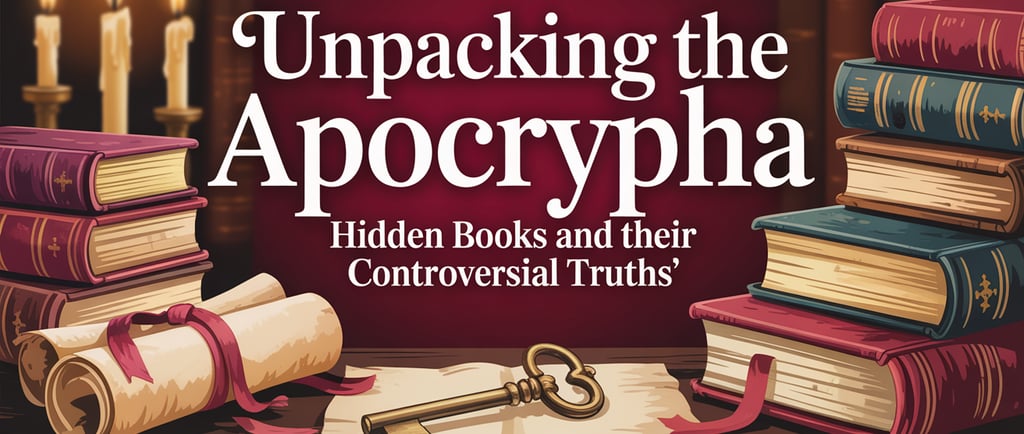
Exploring the Apocrypha: Hidden Books and Their Controversial Truths (A Clear Christian Guide)
Exploring the Apocrypha, a clear Christian guide to hidden books, canon debates, and wise reading. Pastor Richmond, info@faithfulpathcommunity.com
Richmond Kobe
12/29/202514 min read
Many Christians hear the word Apocrypha and feel a quick pause. Is it part of the Bible, a set of banned books, or something in between? That uncertainty is common, especially if you grew up in a tradition that rarely mentions these writings.
In plain terms, the Apocrypha is a collection of Jewish books written in the time between the Old and New Testaments. Different Christian traditions treat them differently, some include them in their Old Testament, others read them as helpful history, but not as Scripture.
This post offers clarity, not conspiracy. While Exploring the Apocrypha, we’ll look at what these books are, why they mattered in Jewish and early Christian life, and why their authority has been debated for centuries. You’ll also see how they can contain wisdom and historical value, while still raising real questions about canon and doctrine.
Scripture remains primary for Christian faith and practice. With that foundation, these books can be studied with discernment, humility, and a steady focus on Christ. For Christian Counseling, Contact Pastor Richmond info@faithfulpathcommunity.com
What the Apocrypha is, and why Christians disagree about it
When Christians talk about Exploring the Apocrypha, they often mean different things without realizing it. That is why conversations can feel confusing fast. The disagreement is not mainly about whether these books have value, it is about where they belong and how much authority they should carry in the church.
Apocrypha, Deuterocanonical, and "hidden": words that cause confusion
These terms sound technical, but the basic idea is simple. The same set of books can get different labels depending on your church background.
Apocrypha: This word can mean hidden, like something kept back or not read publicly. In many Protestant settings, it also means books that are not part of the Bible’s official list (the canon), even if they are useful to read.
Deuterocanonical: This means received later. Catholics often use this word for several Old Testament era books that were accepted as Scripture in the Catholic tradition, even though they were debated in parts of the early church.
Hidden: Some people hear “hidden books” and picture secrets or cover-ups. In reality, “hidden” is usually about how a community treated the books, such as not reading them in worship as often, or placing them in a separate section.
A helpful way to picture it is a bookshelf. Many Protestants treat these writings like good background books beside the Bible. Catholics treat the Deuterocanonical books as part of the Old Testament shelf itself.
For a clear overview of how these terms are often used, see The Apocryphal and Deuterocanonical Books.
Where these books came from: the time between the Testaments
Most Apocrypha-related books fit into the stretch from about 300 BC to 100 AD, the years between the Old Testament prophets and the New Testament era. It was a tense period for Jewish life and worship.
Jewish communities lived under major outside powers, first Greek influence (especially after Alexander the Great), then Roman rule. That pressure was not just political. It affected language, education, public life, and even what faithfulness looked like day to day. Some Jews adopted Greek ways, others resisted, and many felt pulled in both directions.
These writings helped communities hold on to faith when the ground felt unstable. Different books served different needs:
Wisdom teaching: practical guidance for living faithfully, even when culture pushes the other way.
Courage stories: examples of endurance, martyrdom, and loyalty to God under threat.
Prayers and worship: words for grief, repentance, and hope when people felt powerless.
History and identity: reminders of where the community came from, and why it mattered.
Think of them like letters and journals from hard seasons. They may not all function like Scripture in every tradition, but they show what God’s people wrestled with as they waited for the Messiah.
A quick map of canons: Protestant, Catholic, and Orthodox
The main Christian disagreement is about the Old Testament canon, meaning the official list of books read as God’s Word in the church.
Here is a simple snapshot:
Protestant churches: Usually do not include these books in the Old Testament canon. Many Protestant Bibles either omit them or place them in a separate section labeled “Apocrypha.”
Catholic Church: Includes seven core books (plus added sections to a few Old Testament books) as part of the Old Testament. Catholics tend to call these the Deuterocanonical books.
Eastern Orthodox churches: Often include most of the same books Catholics include, and in many cases a few more. Exact lists can vary by Orthodox tradition.
This is not just about counting books. It is about what a church believes should be used to teach doctrine, shape worship, and settle disputes.
How the debate formed: Hebrew Bible, Greek Septuagint, and church decisions
A big part of the story involves two important streams of Jewish Scripture.
The Hebrew Bible: the Scriptures preserved and read in Hebrew (and some Aramaic), which became the standard collection recognized in Jewish tradition.
The Greek Septuagint (often called the LXX): a Greek translation of Jewish Scriptures that was widely used, especially by Jews living outside Israel, and later by many early Christians.
Many of the debated books were preserved and read in the Greek Septuagint tradition, which matters because the early church spread quickly into Greek-speaking areas. Early Christians often quoted Scripture in Greek, and many believers first encountered the Old Testament through that Greek Bible.
Over time, churches had to answer practical questions: Which books should be read in worship? Which writings carry full authority for doctrine? That is where regional differences and church councils entered the picture.
During the Reformation, many Protestant leaders challenged the status of these books and pushed for an Old Testament canon aligned more closely with the Hebrew Bible. In response to the wider debate, the Catholic Church reaffirmed its canon at the Council of Trent (1546). A basic reference point for that decision is the Canon of Trent.
So the disagreement did not begin as a modern argument. It grew over centuries, shaped by language, geography, worship practice, and differing views on how God guided the church in recognizing Scripture.
A readable guide to the main Apocrypha books and what they teach
When you’re Exploring the Apocrypha, it helps to stop thinking of it as one “mystery book” and start seeing it as a small library. Some books read like Bible-era stories, some are history written under pressure, and others are wisdom and prayers for hard seasons.
Below is a plain-language guide to the most-read Apocrypha books and their main messages, with a note on why many Christians find them meaningful, and why their place in the canon is still debated.
Story and courage books: Tobit, Judith, and the Additions to Esther and Daniel
These books feel familiar because they often sound like Old Testament storytelling. They feature faithful families, national danger, God’s rescue, and bold obedience when the odds look bad.
Tobit is a family story about faithfulness in exile. Tobit tries to honor God through prayer, charity, and obedience, even when life falls apart. He becomes blind and his family hits a breaking point, but the story turns on God’s hidden help through the angel Raphael, who guides Tobit’s son, protects him, and leads to healing and restored joy. The takeaway is simple: God sees ordinary faithfulness, and he can bring help through means we don’t expect. For a helpful overview, see BibleProject’s summary of Tobit.
Judith reads like a rescue story in a national crisis. A powerful enemy threatens God’s people, leaders are fearful, and everything feels one step from collapse. Judith, a faithful widow, steps forward with courage, wisdom, and daring action. Her story spotlights deliverance through bold faith, and it honors the kind of courage that doesn’t wait for perfect conditions.
The Additions to Esther add prayers and extra scenes that make God’s presence more explicit. In the Hebrew book of Esther, God is never named, even though his providence is clear. These additions fill in that spiritual “soundtrack” with prayers, motives, and details that underscore fasting, repentance, and God’s rescue.
The Additions to Daniel are three well-known story pieces:
Susanna shows Daniel exposing corruption and protecting an innocent woman through wise judgment.
Bel and the Dragon mocks idol worship and exposes religious fraud, showing that false gods can’t stand up to truth.
The Song of the Three Holy Children (linked to Daniel’s fiery furnace scene) is a worshipful prayer of trust, praising God while suffering.
Why these feel biblical, and why they’re debated: They use familiar patterns, faithful people in danger, God’s rescue, prayers in crisis, and warnings against idolatry. Many Christians love them for that reason. The debate is about canon and authority, not whether the stories are moving. Some traditions receive them as Scripture, while others read them as edifying literature that echoes biblical themes without carrying the same weight in doctrine.
History under pressure: 1 and 2 Maccabees and why they matter
If you want to understand the emotional world behind parts of the New Testament, the Maccabean period matters. These books cover Jewish suffering and resistance during the rule of Antiochus IV Epiphanes, a Seleucid ruler who pushed harsh Greek religious policies. The crisis centered on identity: Would God’s people keep covenant faith, or blend in to survive?
1 Maccabees reads like straightforward history. It traces the revolt led by the priestly family of Mattathias and his sons, especially Judas Maccabeus. You see battles, strategy, and leadership choices, but underneath it all is a hunger to protect temple worship and covenant loyalty. It explains why the temple’s purification became so important in Jewish memory, a backdrop connected to the Feast of Dedication (Hanukkah).
2 Maccabees covers overlapping events, but with a different tone. It is more like a theological retelling, highlighting God’s justice, mercy, and the spiritual meaning of suffering. It gives graphic attention to martyrdom, showing believers who choose death rather than deny God. It’s meant to form courage, not just record facts.
Key themes that show up in both books include:
Faith under persecution: Obedience matters when obedience costs you something.
The temple and worship: Public worship and holiness are treated as non-negotiable.
Martyrdom and hope: Some believers die, trusting God will vindicate them.
A controversial point many Christians notice appears in 2 Maccabees, where prayers and offerings are made on behalf of the dead. For Catholics, this connects to later teaching about prayers for the dead; many Protestants reject that conclusion and point to it as a reason they don’t treat 2 Maccabees as Scripture. If you want an accessible visual overview of both books, see BibleProject’s summary of 1 Maccabees and BibleProject’s summary of 2 Maccabees.
Wisdom for daily life: Sirach and Wisdom of Solomon
Not every Apocrypha book is about war or courtroom drama. Some are built for the slow work of discipleship, the kind that shapes speech, money habits, and integrity when nobody is watching.
Sirach (also called Ecclesiasticus) is like Proverbs in both style and purpose. It offers practical teaching on:
Speech: guarding your tongue, avoiding gossip, and speaking with restraint.
Money and generosity: warning against greed, praising honest work, and urging care for the poor.
Family and friendships: honoring parents, choosing friends wisely, and practicing loyalty.
Fearing God: treating reverence as the foundation of a stable life.
Sirach often feels like a wise mentor pulling you aside after worship and saying, “Here’s how to live this out on Tuesday.”
Wisdom of Solomon is more reflective and poetic. It focuses on what wisdom is, why righteousness matters, and how God sees the faithful when the world calls them foolish. It also speaks with hope about life beyond death, encouraging believers who feel surrounded by injustice. The tone is less “do this, avoid that,” and more “hold steady, God will judge rightly.”
These two books can support Christian growth because they press you toward holy habits and patient trust. Still, many churches that value them for reading and teaching don’t treat them as Scripture for settling doctrine, because of long-standing canon differences.
Prayers and exile themes: Baruch, the Epistle of Jeremiah, and the Prayer of Manasseh
Several Apocrypha writings sound like they were born in a long night, when God’s people were scattered, ashamed, and trying to find their way back.
Baruch is tied to the exile story world. It speaks the language of confession, grief, and renewed commitment. The heart of the message is that sin has consequences, but turning back to God is still possible. Baruch frames repentance as more than feeling bad; it’s returning to wisdom, covenant loyalty, and worship.
The Epistle of Jeremiah (sometimes included with Baruch) is a focused warning against idols. It repeats a simple point from many prophets: idols look impressive, but they cannot speak, save, or sustain life. The letter exposes idolatry as both spiritual and practical foolishness, a reminder that exile often comes after years of trading the living God for something man-made.
The Prayer of Manasseh is short, but it carries weight. It’s written as the repentance prayer of King Manasseh, a ruler remembered for grave sin (see 2 Kings 21). The prayer models honest confession, humility, and a plea for mercy. Many readers return to it because it puts words to the moment when you stop defending yourself and finally say, “Lord, I need forgiveness.”
For Christian Counseling, Contact Pastor Richmond info@faithfulpathcommunity.com
Controversial truths: the teachings that spark debate
When Exploring the Apocrypha, some debates are not about odd details, they are about what shapes doctrine. These books can reflect real Jewish practice and sincere faith, but Christians disagree on how much weight they should carry. A wise approach is to read carefully, compare with clear Scripture, and avoid quick conclusions.
Prayers for the dead, purgatory, and why 2 Maccabees is often the flashpoint
In simple terms, 2 Maccabees 12:38-46 describes Judas Maccabeus collecting an offering and arranging prayers connected to fallen soldiers. The point is that it was seen as good to ask God for mercy for the dead.
Catholics often read this as support for praying for the dead and as a piece of the wider case for purgatory (see Franciscan Media on purgatory and praying for the dead). Many Protestants see a conflict with their understanding of salvation, judgment, and the sufficiency of Christ’s finished work.
A helpful distinction is this: historical practice shows what some faithful people did, binding doctrine answers what the church must teach.
Angels, demons, and spiritual help in Tobit: comfort or concern?
Tobit includes Raphael guiding Tobias, a demon afflicting Sarah, and healing for Tobit’s blindness. Some readers feel comforted because it highlights God’s care through unseen help. Others feel cautious because some details are not echoed in the New Testament in the same way, which affects how confidently they build beliefs from it.
Don’t build a whole spiritual routine from one debated source. Let clearer passages set the boundaries.
History questions and why genre matters
Critics point to timeline or setting questions in parts of the Apocrypha. Supporters may treat some sections as edifying story rather than strict reporting.
Genre shapes expectations:
History records events.
Wisdom trains character.
Devotional story teaches through narrative.
Are these books quoted in the New Testament, and does that settle it?
The New Testament quotes the Old Testament often, but not every accepted book is quoted, and not every allusion proves canonicity. Quotation patterns matter, they just aren’t the only factor in canon discussions. For more faith-building resources, visit the Faith Path blog on spiritual growth.
For Christian Counseling, Contact Pastor Richmond info@faithfulpathcommunity.com
How to read the Apocrypha as a Christian without losing your footing
Exploring the Apocrypha can feel like walking into a library room that some Christians love and others avoid. The safest way to read it is to keep your Bible open, keep your expectations clear, and remember what the Apocrypha is meant to be for you: background, wisdom, and witness, not a new foundation for faith.
If you treat these books like a helpful companion volume, not a rival authority, you can learn a lot without getting pulled into confusion.
Start with a purpose: history, wisdom, or prayer
Most people lose their footing because they start with the wrong question. Instead of asking, “Is this secret truth?”, start with, “What kind of book is this, and why am I reading it?”
A simple, steady path looks like this:
Begin with Sirach (wisdom)
Then read Tobit or Judith (story)
Finish with 1 Maccabees (history)
Sirach (wisdom):
Sirach is like a tough, practical coach for everyday faith. It pushes you toward honesty, steady speech, humility, generosity, and reverence for God. Read it the way you read Proverbs: looking for patterns that form character.
What Sirach offers:
Clear moral instruction that often echoes biblical wisdom
Advice that exposes pride, greed, and loose speech
What Sirach does not offer:
A replacement for Scripture’s authority
A place to build new doctrine when the Bible is clear elsewhere
Tobit or Judith (story):
Pick one. These narratives are easier to read than you might expect, and they show what faithfulness looked like for Jews living under pressure. Stories help you feel the world between the Testaments.
What these stories offer:
A picture of courage, prayer, and loyalty when life feels unstable
A reminder that ordinary obedience still matters when you feel unseen
What they do not offer:
A “how-to” manual for spiritual practices
A set of promises you can claim without checking the rest of Scripture
1 Maccabees (history):
If you want historical footing, 1 Maccabees is one of the best entry points. It helps explain the conflict, grief, and courage that shaped Jewish life right before the New Testament era.
What 1 Maccabees offers:
A clearer sense of the events leading up to the time of Jesus
Context for themes like persecution, temple worship, and national identity
What it does not offer:
A shortcut for understanding the gospel
A reason to treat the New Testament like an optional “Part 2”
If you want a quick, balanced explanation of why these books appear in some Bibles and not others, this overview helps: https://bibleproject.com/articles/why-deuterocanon-apocrypha-some-bibles-and-not-others/
Use a simple filter: what agrees with clear Bible teaching?
A wise way to read the Apocrypha is the same way you should read any Christian book, sermon, or commentary. You learn, you test it, and you only keep what matches the gospel.
Here’s a three-step habit you can use every time you read:
Read the passage straight Don’t hunt for hidden codes. Ask basic questions: What is happening, who is speaking, what is the main point?
Compare it with clear teachings in the Bible Use “bright-line” passages, texts that are direct and repeated across Scripture (salvation by grace through faith, the call to holiness, God’s character, the uniqueness of Christ).
Apply only what fits the gospel and godly character If a verse pushes you toward humility, repentance, mercy, truth-telling, and worship, it likely serves you well. If it pushes you toward fear, pride, or spiritual bargaining, slow down and test it harder.
This filter keeps Exploring the Apocrypha from becoming a shaky side mission that pulls you away from Jesus.
When something confuses you, don’t isolate. Bring the question to someone mature in the faith. A short talk with a pastor or trusted mentor can prevent weeks of anxious overthinking.
If you want a brief Protestant-friendly answer to whether Christians should read these books at all, this is a helpful listen: https://learn.ligonier.org/podcasts/ask-ligonier/should-christians-read-the-apocryphal-books
Choose trustworthy editions and avoid online "lost book" hype
One of the biggest problems today is that “Apocrypha” gets mixed up with anything ancient and mysterious. You’ll see videos claiming “lost books” were removed to hide truth. Most of that is noise.
The Biblical Apocrypha (Deuterocanonical books) are a specific set of Jewish writings connected to the Old Testament era and widely read in parts of the early church.
Other ancient writings often get lumped in, even when they are different in origin and purpose, such as:
1 Enoch
Jubilees
Other collections often called pseudepigrapha (texts written under a famous name)
Those writings can be interesting for historical study, but they are not the same category as the Apocrypha found in many Bible editions. If you want a scholarly, careful definition of these categories, see: https://www.oxfordbibliographies.com/display/document/obo-9780195393361/obo-9780195393361-0007.xml
A practical safeguard is simple: read from reputable editions, not random screenshots and stitched-together clips.
Two reliable options many Christians use:
A well-reviewed study Bible that includes the Apocrypha (example listing): https://biblegateway.christianbook.com/oxford-annotated-apocrypha-revised-standard-version/9780190276072/pd/276072
A mainstream publisher’s Bible with Apocrypha (example listing): https://www.zondervan.com/p/nrsvuebible/nrsvue-bibles-protestant-canon-with-apocrypha-copy/
A good rule for online content: if the teacher needs panic, outrage, or conspiracy to hold your attention, it’s probably not worth your trust.
When the topic hits close to home: doubts, family conflict, and spiritual anxiety
Canon debates can get personal fast. Maybe you feel like you were never told the whole story. Maybe someone in your family treats the Apocrypha as a threat, or as proof your church is wrong. Maybe your own thoughts spiral when you hear confident voices arguing on both sides.
When that happens, anchor yourself in what does not move:
Jesus is Lord, risen and reigning.
The gospel is clear, Christ saves sinners by grace.
Core doctrines do not hang by a thread on one disputed text.
It also helps to name what’s really happening. Often the fear isn’t, “What do I think about Tobit?” It’s, “Can I trust God to lead his people?” That’s a spiritual question, not just a book list question.
If your home life gets tense, keep the goal modest. You don’t need to win the canon debate at the dinner table. You can say, “I’m reading to understand history, and I’m keeping Scripture first.” That humble sentence can lower the temperature.
For Christian Counseling, Contact Pastor Richmond info@faithfulpathcommunity.com
Conclusion
Exploring the Apocrypha doesn’t have to shake your faith, it can steady it. These books help frame the world between the Testaments, the pressures God’s people faced, and the questions that shaped early Jewish life and the first Christians. They also explain why Christians still differ on what belongs in the canon, and why your tradition’s view of Scripture matters when forming doctrine.
Read these writings with humility and clear priorities. Let the Bible remain your final authority, then test themes from the Apocrypha against plain, repeated teaching in Scripture. When you hit a difficult passage, don’t treat it like a private puzzle. Seek wise guidance, because discernment grows best in community.
This week, pick one book and read it slowly. Start with Sirach for practical wisdom, or Tobit for a faith-in-exile story. Bring one key takeaway and one hard question to your pastor or small group, then ask how it fits with the gospel and the life of Christ.