
The Euphrates River Prophecy Today: Revelation 16:12, Armageddon, and a Calm Christian Response
The Euphrates River Prophecy, Revelation 16:12, Armageddon, and a calm late-2025 Euphrates update. Christian counseling: info@faithfulpathcommunity.com
Richmond Kobe
12/29/202514 min read
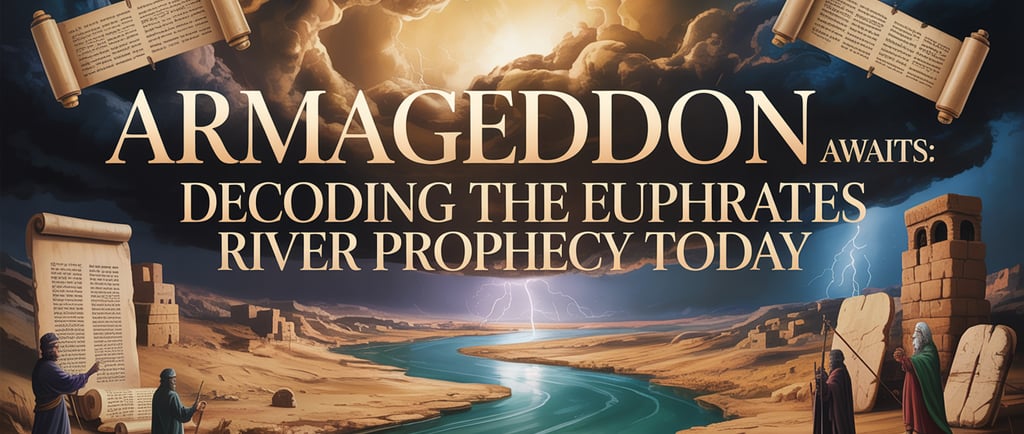
Headlines about a shrinking Euphrates can stir up end-times fear fast. Many Christians hear about drought, dams, and regional tension, then think of The Euphrates River Prophecy and Armageddon.
Revelation 16:12 does mention the Euphrates, but Scripture deserves careful reading, not panic. This post will walk through the text, what it says (and what it doesn’t), and how it fits within the wider story of the Bible.
We’ll also look at what’s happening with the Euphrates in late 2025 in plain terms: harsh drought, very low river levels, strained water releases from upstream dams, and real conflict pressures among Turkey, Syria, and Iraq. These realities matter for people living there, and they often shape how prophecy claims spread online.
Most of all, we’ll focus on a steady Christian response that’s watchful, wise, and prayerful. This isn’t date-setting or fear-driven teaching, it’s a call to hold current events and God’s Word in the right order.
For Christian Counseling, Contact Pastor Richmond info@faithfulpathcommunity.com
What Revelation 16:12 Actually Says About the Euphrates
Revelation 16:12 is short, but it carries a lot of weight in prophecy talk. It says the sixth angel poured out God’s bowl judgment on “the great river Euphrates,” and its water was “dried up,” so “the way of the kings from the east might be prepared” (wording varies by translation). You can compare translations and see a range of Christian commentary in one place at Bible Hub’s Revelation 16:12 commentaries.
That’s the core of The Euphrates River Prophecy in Revelation: a barrier is removed, and a path is opened, not because evil is winning, but because God is moving history toward a final reckoning.
The Euphrates in the Bible: A Real River with a Big Story
The Euphrates is not a made-up symbol. It’s a real river that runs through the heart of the Middle East, and Scripture treats it like a major landmark with a long memory.
In the Bible, the Euphrates often signals big themes:
Borders and promises: It shows up in boundary language connected to God’s covenant promises, the idea of a clear edge to a land and a people.
Empires and invasion routes: Major powers rose and moved along that corridor. In Israel’s story, threats often came from the east and north, traveling the same regional pathways connected to the Euphrates.
Babylon and exile: The river ties into the world of Babylon, which becomes both a real empire in the Old Testament and a loaded symbol in prophetic writing for human pride, oppression, and rebellion against God.
That mix matters when you read Revelation. John uses places we can point to on a map, but he also uses them the way the prophets did, as images that carry history. A physical river can still function like a signpost, pointing to God’s past acts and God’s final justice.
What Does "Dried Up" Mean in Prophecy Writing?
“Dried up” can sound like a simple news headline, but Revelation is full of vivid signs and Old Testament echoes. Christians generally land in a few main camps here, and each one tries to honor the text in a careful way.
Here are common understandings, stated plainly:
A literal drying of the river: Some read Revelation 16:12 as a real, physical event near the end, where the Euphrates becomes passable in a way it normally isn’t.
A removed barrier: Others see the river as a natural boundary. In that view, “dried up” means the restraint is taken away, like when a locked gate is opened and an invading force can move through.
God making a way for judgment: Another approach emphasizes the purpose line in the verse, “so that the way… might be prepared.” The focus is less on water levels and more on God actively arranging events so evil is gathered and exposed.
A simple example helps. A river can function like a wall in the landscape. If that wall drops, movement becomes easier, for trade, migration, or invasion. Revelation uses that kind of clear, physical picture to communicate a spiritual point: when God says it’s time, obstacles that once slowed events can vanish fast.
If you want a straightforward verse-by-verse explanation across translations, BibleRef’s summary of Revelation 16:12 is a helpful starting point.
Who Are the "Kings from the East" and Why Do They Matter?
The “kings from the east” (sometimes translated “kings of the east”) are part of the bowl judgments leading up to Armageddon. Readers often want a direct list of modern nations, but Revelation doesn’t hand us that. It gives an image with enough clarity to make a point, but enough restraint to keep us from false certainty.
Major interpretations usually fall into three broad groups:
Literal nations east of Israel: Some Christians connect the phrase to actual rulers and armies from regions east of the Euphrates, seeing a future military movement toward the land of Israel.
A broad end-times coalition: Others read “kings” as a wider alliance of powers, not necessarily limited to one region, gathered into a single push against God’s purposes.
Symbolic enemy powers: Another view treats the phrase as a picture of organized rebellion, the “east” functioning like a direction marker for threat, distance, and looming conflict.
No matter where you land, the passage aims at the same steady takeaway: God isn’t surprised, and evil doesn’t assemble itself outside of God’s control. The river “drying up” doesn’t mean God lost control of the map. It means the Judge of all the earth is letting history move to its appointed end, where deception is uncovered and justice is done.
For Christian Counseling, Contact Pastor Richmond info@faithfulpathcommunity.com
Armageddon in Revelation: What It Is, What It Isn’t
In Revelation, Armageddon is not presented as a random world war that breaks out because humans lose control. It’s shown as a final gathering that happens under God’s judgment, where deception is exposed and rebellion is brought into the open.
That matters for how you read headlines and how you think about The Euphrates River Prophecy. Revelation’s point is not to feed panic or endless prediction, it’s to steady God’s people with truth: evil can organize, but it can’t outrun the Lord.
Where Armageddon Shows Up in the Story of Revelation
Armageddon appears in the flow of the seven bowls of wrath in Revelation 16. By the time you reach the sixth bowl, the picture is already one of the world hardening itself against God, even as judgment falls.
Revelation 16:12 sets the stage by describing the Euphrates being dried up, preparing “the way” for rulers from the east. Then Revelation 16:13-14 shifts to a warning about deception. John describes “unclean spirits” going out to gather the kings of the whole world for battle. You don’t have to pin down every symbol to get the plain message: dark spiritual influence pushes leaders and nations toward a united defiance against God.
Then comes a sharp, personal interruption: “Behold, I am coming like a thief” (Revelation 16:15). This line does not function like trivia in a prophecy chart. It’s Jesus pressing the pause button and speaking to His people in real time: stay awake, stay ready, don’t drift into spiritual sleep.
A simple way to hold the sequence together is this:
God pours out judgment: the bowls show God acting in history, not reacting late.
Deception intensifies: evil does not just rage, it lies, recruits, and gathers.
Jesus calls for watchfulness: readiness is the right response, not obsession.
The gathering happens: Armageddon is named as the place of assembly (Revelation 16:16).
If you want a clean overview of where Armageddon fits in Revelation 16, Enter the Bible’s summary of Revelation 16:16 is a helpful guide.
Why Christians Disagree on the Timeline
Futurist: Futurists read much of Revelation, especially chapters 4 to 22, as describing events that are still ahead of us. In this view, the bowls of wrath and the gathering at Armageddon point to a future, climactic period near the end of history. People who hold this view often watch global events closely, but careful futurists still warn against date-setting and rumor chasing.
Historicist: Historicists see Revelation as a broad map of church history from the time of John to the end. Instead of one short future window, the symbols track long eras and major shifts over centuries. In that approach, “Armageddon” can be tied to a final stage in a long unfolding conflict, not only a single end-times week.
Idealist: Idealists treat Revelation as a symbolic portrait of the ongoing battle between Christ’s kingdom and the powers of darkness in every age. The scenes are real and true, but not meant to be pinned to one narrow timeline. In this view, Armageddon represents the repeated pattern of worldly powers gathering against God, and the final victory of Christ that those patterns point toward.
Preterist: Preterists connect large parts of Revelation to events that were near to John’s first readers, including persecution and conflict in the Roman world. Some preterists still expect a future final return of Christ, but they see many of Revelation’s warnings and judgments as already fulfilled in the first century context. Armageddon, in that reading, is less about modern headlines and more about how God judged and unmasked rebellion in that earlier era.
For a short, clear explanation of these four views, Ligonier’s “Four Ways to Read the Book of Revelation” lays out the basics without turning it into a fight.
The Main Point: God Calls His People to Stay Faithful
It’s easy to treat Armageddon like a code to crack. Revelation treats it more like a mirror that asks, “Who do you worship, and will you endure?”
Right in the middle of the Armageddon passage, Jesus blesses the one who stays awake and keeps their “garments” (Revelation 16:15). The image is simple: keep your life spiritually covered, don’t live careless, don’t drift into shame. Readiness in Revelation looks like steady faithfulness, not frantic scanning of every rumor.
Here is what staying faithful looks like in daily life, especially when end-times talk gets loud:
Stay grounded in Scripture: read Revelation with the rest of the Bible in view, not as a stand-alone puzzle.
Don’t chase rumors: when a claim stirs fear fast, slow down and test it, even if it sounds spiritual.
Live with repentance and hope: keep short accounts with God, confess sin quickly, and keep your eyes on Christ’s return.
Choose worship over panic: worship re-centers the heart, panic shrinks God and enlarges threats.
Practice endurance: keep doing the next right thing, prayer, obedience, love of neighbor, even when you don’t understand every detail.
Armageddon, whatever your timeline view, is not meant to make you feel helpless. It’s meant to call you to holiness with your eyes open. The message is steady: deception is real, pressure will come, Jesus will return, and those who belong to Him are called to stand.
For Christian Counseling, Contact Pastor Richmond info@faithfulpathcommunity.com
What’s Happening to the Euphrates River in Late 2025, and Why People Are Paying Attention
By late 2025, the Euphrates River is not just “low.” In many places, it’s stressed in ways people can see and feel: shallower channels, weaker flow, and shrinking reservoirs that normally act like savings accounts for the dry season.
That reality gets attention for two reasons at once. First, it affects daily life for millions of families in Turkey, Syria, and Iraq. Second, the Euphrates shows up in Revelation 16:12, so any news about the river can quickly get pulled into prophecy talk. It helps to slow down, separate facts from fear, and understand what’s driving the crisis on the ground.
For Christian Counseling, Contact Pastor Richmond info@faithfulpathcommunity.com
Drought, Heat, and Evaporation: The Environmental Side
The simplest way to explain the environmental side is this: less water comes in, and more water is lost.
When rainfall is low for years in a row, the river starts each season behind. When heat rises, water disappears faster from river channels, farm canals, and reservoirs. Evaporation is like leaving a cup on the counter in a hot room, it drops even if nobody touches it. Now picture that happening across a whole watershed.
Late-2025 reporting has described sharp flow declines and record-low reservoir levels, especially in Iraq, where storage lakes and key reservoirs have dropped to alarming lows. NASA satellite reporting has highlighted how far some major reservoirs have fallen during this multi-year drought, which adds strain on farmers and water managers who rely on those buffers to get through summer and low-flow months (https://science.nasa.gov/earth/earth-observatory/iraq-reservoirs-plunge-to-low-levels/).
This is not an abstract climate story. People downstream feel it in everyday ways:
Farms lose predictability: When flow drops, irrigation becomes rationed, planting gets delayed, and harvest plans turn into guesses. A field can look fine one week, then burn up the next if water allocations change.
Drinking water becomes harder to treat: Low water often means higher concentration of pollutants and salt, which makes treatment tougher and more costly.
Power supply gets weaker: Hydropower depends on consistent releases and reservoir height. When reservoirs fall, electricity output can drop, and that can ripple into hospitals, schools, and basic services.
Health risks rise: Stagnant, warmer water can fuel algae growth and other water quality problems, which can spread illness when systems are stressed.
If you want a mental picture, think of the Euphrates system like a long shared pipeline with a storage tank at the end. In a wet year, the tank fills and everyone has margin. In a dry year, everyone is watching the gauge, and the margin disappears.
Dams, Water Releases, and Politics Between Turkey, Syria, and Iraq
The Euphrates starts upstream, then travels through multiple borders. That means dams and water releases upstream shape life downstream, even when nobody intends harm. It’s basic geography mixed with modern infrastructure.
Turkey has major dams and projects on the upper Euphrates. Syria also has dams and needs power and irrigation. Iraq sits downstream and depends heavily on what comes through. When rainfall is weak, every country feels pressure to protect its own needs first, which is why water becomes a sensitive part of regional politics.
In late 2025, reports have linked reduced downstream flow to a mix of drought conditions and dam operations. As conditions tighten, negotiations matter more, because a change in releases can mean the difference between:
a town getting steady municipal water, or moving to emergency trucking
farms keeping crops alive, or losing a season’s income
a power station running reliably, or producing less electricity
This is also why water can become a pressure point in conflict zones. In places where trust is low and security is fragile, water is not just a resource, it can become a bargaining chip, a grievance, or a rumor that spreads fast.
Recent reporting has highlighted new cooperation efforts between Turkey and Iraq tied to water and infrastructure, including agreements described as “oil-for-water” arrangements. One overview of the late-2025 deal and what it aims to do is summarized here: https://www.al-monitor.com/originals/2025/11/turkey-iraq-sign-oil-water-deal-what-know.
It’s wise to read these stories with a balanced mindset. Governments have real incentives to present progress, and real limits on what they can deliver quickly. But cooperation still matters, because long droughts do not respect borders. They punish everyone, just in different ways.
Does Today’s Crisis "Fulfill" Revelation 16:12? How to Think Clearly
Many believers see the Euphrates dropping and think, “Is this The Euphrates River Prophecy happening right now?” That question makes sense, because Revelation 16:12 does picture the river being dried up to prepare “the way” for kings from the east.
Here’s a careful way to hold it: current events can resemble biblical images, but resemblance is not proof.
A river running low can remind people of Revelation’s language. But the passage sits inside a larger chain of end-times judgments and global gathering. Treating today’s drought as a certain “fulfillment” usually requires more than a scary headline.
In plain terms, here’s what leads people to claim fulfillment:
A truly dried-up Euphrates: Not just low in places, but dried to the point that it clearly “prepares a way” for large-scale movement and crossing.
A broader Revelation 16 context: The Euphrates detail is part of the sixth bowl judgment, surrounded by other dramatic signs and the gathering described near Armageddon.
A clear connection to the “kings from the east” idea: The text focuses on preparing a way for rulers, not simply describing a humanitarian disaster.
At the same time, here’s why Christians should avoid confident predictions:
Prophecy is not a guessing game: Scripture calls us to watchfulness and faithfulness, not to prove we can forecast dates.
Events can be reversible: Rain, policy shifts, and releases can change water levels. Some late-2025 reports already noted temporary rises from weather and releases, even while conditions stayed critical.
Fear can hijack discernment: When anxiety is in the driver’s seat, people start treating every development as a sure sign.
A steadier posture is possible. We can pray for the people who depend on the Euphrates, support wise water policies, and reject rumor culture. We can also keep Revelation where God put it, as a call to endurance and holiness, not a tool for panic.
For Christian Counseling, Contact Pastor Richmond info@faithfulpathcommunity.com
How Christians Can Respond Without Fear: Wisdom, Prayer, and Readiness
When headlines about the Euphrates spike, fear can spread faster than truth. But Christians aren’t called to live on adrenaline. Even when events seem to line up with The Euphrates River Prophecy, the Bible’s repeated pattern is clear: God calls His people to watchfulness, prayer, and steady faith.
Think of it like driving in heavy fog. You don’t speed up, and you don’t slam the brakes. You slow down, turn on the right lights, and keep moving with care.
Practice Watchfulness, Not Panic
Watchfulness means you stay awake spiritually, but you don’t feed your mind a constant stream of alarming content. Panic makes people easy to manipulate, and end-times talk can become a magnet for exaggeration.
Here are simple ways to stay grounded without going numb:
Set limits on news intake.
Choose a short window to catch up, then stop. If your phone is discipling you more than Scripture does, it’s time to reset.Test claims before you repeat them.
Ask a few basic questions: Who said this? What proof is offered? Is this reporting, opinion, or a clipped video with no context? If it stirs fear fast, slow down and verify.Read Scripture in context, not as isolated headlines.
Revelation 16:12 sits inside a larger passage about judgment, deception, and Christ’s call to stay ready. Reading the full section helps you avoid turning one verse into a panic trigger. A side-by-side view of the surrounding verses can help when you want to read carefully, such as Revelation 16:14-17 in multiple translations.Talk with trusted church leaders.
If a claim has you unsettled, bring it to a pastor or mature believer who can help you think clearly. You don’t have to carry prophecy anxiety alone.
Watchfulness isn’t about cracking codes. It’s about obedience today. If Jesus returned tonight, what would faithfulness look like this afternoon? Keep that question close. It has a way of clearing the fog.
Pray for the Region and Support Mercy Work
The Euphrates crisis is not just a prophecy conversation, it’s a human reality. Families downstream face water shortages, crop loss, power issues, and the pressure that comes with instability. When you pray, you are not performing a ritual. You are joining your heart to God’s care for real people.
Here are specific prayer points you can use this week:
Rain and steady water supply: Ask God for timely rain, refill of reservoirs, and relief from extreme heat.
Wise water management: Pray for leaders and engineers to act with honesty, skill, and restraint.
Protection for civilians: Ask God to guard families, hospitals, and aid workers in vulnerable areas.
Peace and reduced conflict pressure: Pray for restraint where tensions are high, and for channels of cooperation to hold.
Fair agreements across borders: Ask God for just arrangements that don’t crush those downstream.
Help for displaced families: Pray for shelter, food, medical care, and safe paths forward for those forced to move.
Along with prayer, consider giving or serving through trusted ministries that have a record of transparent mercy work. Even small, consistent support can feel like a cup of cold water in a dry place.
Get Your Heart Ready: Repentance, Hope, and Steady Faith
Readiness in Revelation is not mainly about knowing the sequence of events. It’s about being faithful to Jesus when pressure rises and deception thickens. That kind of readiness is built the same way a strong house is built, one day at a time, with steady choices.
A few daily practices keep your heart clear and your hope strong:
Confession: Name sin plainly, agree with God, and receive His forgiveness. Hidden sin feeds fear because it fractures assurance.
Forgiveness: Release grudges before they harden. Unforgiveness is like carrying a backpack of stones into a long walk.
Reconciliation: When possible, take the first step toward peace. A simple text, call, or honest apology can reopen what pride sealed shut.
Witness: Live in a way that makes Christ believable, calm words, clean habits, and compassion for neighbors who are scared.
End-times talk can tempt us to obsess over timelines while neglecting obedience. But spiritual readiness is not a special project for “later.” It’s the fruit of ordinary discipleship, done with a steady heart.
For Christian Counseling, Contact Pastor Richmond info@faithfulpathcommunity.com
Conclusion
Revelation 16:12 is serious. It shows God removing a barrier as history moves toward judgment, not as a cue for Christians to panic. The Euphrates River Prophecy points to God’s control over the end of the story, even when the details are debated.
Armageddon is also real in the biblical storyline, a final gathering where deception is exposed and Christ’s victory stands clear. That truth should produce steady obedience, not constant forecasting or rumor-sharing.
At the same time, the Euphrates is facing a real crisis in 2025. Drought, heat, and water politics are squeezing communities downstream, and the human cost is not theory. Christians can hold both realities at once, taking Scripture seriously and caring about people without forcing every headline into a chart.
Let this move you toward prayer, repentance, and calm readiness, then toward mercy for those who suffer. If you want ongoing encouragement for steady discipleship, visit https://faithfulpathcommunity.com/faith-path-blog-spiritual-growth.
Christ will return, and His people can live watchful and unafraid today.
For Christian Counseling, Contact Pastor Richmond info@faithfulpathcommunity.com